OBADIAH: A MINOR PROPHET WITH A MAJOR MESSAGE
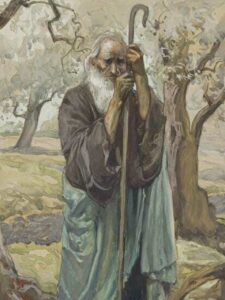
Obadiah, by James Tissot, c. 1900
Wikimedia Commons
By
Jim Gerrish
Unless otherwise indicated, Scripture taken from the HOLY BIBLE, NEW INTER-NATIONAL VERSION® NIV® Copyright © 1973, 1978, 1984, 2011 by Biblica, Inc. All rights reserved worldwide. Used with permission.
Copyright © 2026 Jim Gerrish
Light of Israel Bible Publications
Colorado Springs, CO.
INTRODUCTION
Not only is Obadiah a Minor Prophet, but he has the smallest book in the Old Testament. Yet, he has a major message and one that is pertinent even for our day. Obadiah helps us understand and deal with an almost four-thousand-year-old problem. This problem just might be the most urgent one facing our civilization today. We will try to understand and deal with this problem as we go through this prophet’s book.
We have almost no information about this prophet. We know his name, and that is about all we know. His name in Hebrew means “servant of the Lord, “ or “servant of Yahweh.” 1 There are around a dozen men in the Bible who are named Obadiah, but none of them corresponds to the Obadiah of our book.2
His short message is an exclusive one that is focused on the ancient nation of Edom, also known as Mt. Seir. Edom was founded by Jacob’s twin brother Esau. The two had (and still have) what is almost an eternal rivalry. In Genesis 25, we learn that this rivalry began in their mother’s womb. Esau was destined to be the firstborn, but Jacob grasped his heel even in the birth canal. This strange act illustrates the supernatural and spiritual nature of this rivalry.
The boys were completely different. Esau grew up to be a man of the field. He was a rough, hairy (he may have had red hair from which we get the Hebrew Edom), and a hunter type. He had little interest or use for the family birthright and actually traded it to Jacob for a bowl of stew. Jacob was a man of the home and a quiet, meditative person. He sought after the birthright and the Lord who gave it. We can understand why God loved Jacob, but he hated Esau (Mal. 1:2-3; Rom. 9:13). In biblical terminology, “hate” can often mean “love less.”
Isaac loved Esau and the wild game he brought in and prepared with its savory sauces. He was determined that the birthright would go to Esau. His wife, Rebecca, loved Jacob and would help him get the birthright by subterfuge. So it was that by Jacob’s trickery and his mother’s help, he gained the important birthright with its blessing and became heir of the spiritual heritage of Israel (Gen. 25:29-34). Rebecca had been told by God that her elder son would serve the younger (Gen. 25:23).
Thus, the struggle of the brothers began. It is almost unbelievable, but that struggle rages on in our world today. Very likely, the final battle of the ages will be a battle between two brothers, the chosen and the not chosen.
We might wonder when this little book was written. Scholars have come up with two dates. In 2 Chronicles 21:16-17, there was an attack against Jerusalem that happened during the reign of Jehoram (848-841 BC). This attack was conducted by the Philistines and the Arabians. Then, in 2 Kings chapters 24 – 25, there was the devastating attack of the Babylonians against Jerusalem. This happened in 586 BC.3 Several Bible scholars feel that this is the attack to which Obadiah has reference. Faussett says, “The date of Obadiah’s prophecies was probably immediately after the taking of Jerusalem by Nebuchadnezzar, 588 BC.” 4 This would place Obadiah in the time of the prophet Jeremiah.
Later, we will see how several of their prophecies are very similar and even seem intertwined.
CHAPTER 1
The vision of Obadiah. This is what the Sovereign LORD says about Edom – We have heard a message from the LORD: An envoy was sent to the nations to say, “Rise, let us go against her for battle” – Obadiah 1:1
Here we have a strange thing. God sends out an urgent message for all nations, bidding them to rise up and fight against Edom. We might ask, “What had this nation done to stir up such wrath from God?” It all started with Esau, who lightly regarded the covenant of God and sold his birthright to Jacob, as we have said. Afterward, he hated his brother Jacob and threatened to kill him (Gen. 27:41-45). That bitter enmity lived on in Esau’s people, the nation of Edom.
When the people of Israel were freed from Egyptian slavery and made their way toward the Promised Land, they needed to pass through Edom. However, the people of Esau would not let their brothers pass (Num. 20:14-21, cf. Deut. 2:1-13). Great bitterness persisted through the centuries with the people of Edom against Israel. Then at last, when Jerusalem was being destroyed by the Babylonians, their brothers of Edom gathered to cheer. We read about this in verses 1:10-14. They not only cheered the downfall of their brothers, but they also joined in the battle against them.
The prophets of Israel have much to say about Edom. Some principal prophecies are Isaiah 34:5; 63:1-6; Jeremiah 49:7-22; Lamentations 4:21-22. Edom pops up in many other Scriptures, like Ezekiel 25:12-14; 35:1-15; Psalms 137:7. It is interesting that Obadiah and Jeremiah have some close parallels regarding Edom. Perhaps they had access to each other’s prophecies. Compare Obadiah 1:1a to Jeremiah 49:7; Obadiah 1:1b-4 to Jeremiah 49:14-16; Obadiah 1:5 to Jeremiah 49:9; Obadiah 1:6 to Jeremiah 49:10; Obadiah 1:8 to Jeremiah 49:7; Obadiah 1:9a to Jeremiah 49:22b; and Obadiah 1:16 to Jeremiah 49:12.1
It is clear from Scripture that Edom and Israel had continuing historical problems. We read about these in many passages, such as Numbers 20:14-21; Judges 11:16-17; 1 Samuel. 14:47-48; 2 Samuel 8:14; 1 Kings 11:14-25; 2 Kings 16:5-6; and 2 Chronicles 20:10-30; 21:8ff. Charles Feinberg, biblical professor, says of Obadiah, “It is not quoted in the New Testament, yet its message is a vital part of all the prophetic Scriptures.” 2
A LOOK AT EDOM’S HISTORY
See, I will make you small among the nations; you will be utterly despised. The pride of your heart has deceived you, you who live in the clefts of the rocks and make your home on the heights, you who say to yourself, “Who can bring me down to the ground?” Obadiah 1:2-3
After leaving his father’s house, Esau settled in Mt. Seir. He married pagan wives and began to grow a nation. His people absorbed an earlier nation known as the Horites. We are told in Scripture that Edom developed faster than Israel. In Genesis 36:31, we learn that several kings ruled in Edom before Israel ever had a king. It was easy for Edom to grow and become rich since the nation sat directly on the great Syrio-Arabian trade routes.
Edom’s physical location had a lot to do with its great pride. The country was located in what is today southern Jordan. It was situated on a high plateau. The major city Sela (meaning “rock”) was 2,844 to 2,877 feet (867 to 877 m.) above sea level. The nearby, but later, city of Petra has become quite a tourist attraction today with its famous red rock-cut architecture. Because of its location in the cleft of the rocks, Edom was well fortified, and it was almost impossible for an enemy to conquer it. James Montgomery Boice, American theologian and broadcaster, says of the later city Petra, “Experts say that because of the configuration of the siq [chasm] through which Petra is entered, it would be possible for a dozen men to hold it against an army…” 3 Edom was not a large country. It was only about 20 to 30 miles wide (32 – 48 km.) and about 100 miles long (160 km.).4
Although Edom was small, it was very proud. She was proud of her secure and protected location, she was proud of her wealth, and her wisdom. 1 Kings 4:30 speaks about the wisdom of the men of the East. Jeremiah 49:7 speaks of the wisdom of Edom, which was declining.
EDOM TO BE BROUGHT DOWN
“Though you soar like the eagle and make your nest among the stars, from there I will bring you down,” declares the LORD. Obadiah 1:4
Edom, like the eagle, had built her nest in a most inaccessible place. The nation was very proud, but the Bible declares that pride goes before destruction (Prov. 16:18). The destruction of Edom did not come at once, but it surely came. Utley charts the path of the nation’s collapse. Edom was destroyed by the Neo-Babylonian kingdom around 580 BC. The people of Edom were displaced by the Nabatean Arabs around 550-449 BC (cf. Mal. 1:2-5). Edom then moved to the Negev. They were defeated by Alexander the Great around 312 BC and finally by Judah Maccabaeus around 175 BC. The Maccabees then forced them to accept Judaism in 125 BC, and they began to be called Idumeans. The Roman General, Titus, put an end to Idumean influence in AD 70.5
“If thieves came to you, if robbers in the night – oh, what a disaster awaits you! – would they not steal only as much as they wanted? If grape pickers came to you, would they not leave a few grapes? But how Esau will be ransacked, his hidden treasures pillaged! (1:5-6). Thieves usually do not take everything. Even in our “smash-and-grab” age, the mobs usually leave some things. Grape pickers were commanded to leave gleanings for the poor (Isa. 24:13). But the robbers who came to Edom took everything. Bob Utley, US Baptist scholar and author says, “Edom was a commercial center because of its copper mines, its rich soil, and its geographical location on a major trade route. This phrase may refer to its hidden, commercial storehouses.” 6
“All your allies will force you to the border; your friends will deceive and overpower you; those who eat your bread will set a trap for you, but you will not detect it” (1:7). The Edomites would be plagued with fickle friends, with people they thought were solid allies. James Burton Coffman, American minister and theologian, citing Deane, identifies these allies as Moab, Ammon, Tyre, and Sidon.7 They could have quoted Psalm 41:9: “Even my close friend, someone I trusted, one who shared my bread, has turned against me.”
“‘In that day,’ declares the LORD, ‘will I not destroy the wise men of Edom, those of understanding in the mountains of Esau?’” (1:8). Edom or Mt. Seir was known for its wisdom, as we have mentioned. Boice comments: “Eliphaz, the foremost of Job’s friends and the chief representative in that book of human wisdom, was a Temanite; that is, he was from Edom. Another of Job’s friends was a Shuhite, a name that is still given to a mountain in Edom.” 8 Of course, Teman was another of the cities of Edom. 1 Kings 4:30 and Jeremiah 49:7 speak and declare the great wisdom of the East.
“Your warriors, Teman, will be terrified, and everyone in Esau’s mountains will be cut down in the slaughter” (1:9). Teman was really a major city of Edom. It was named after a grandson of Esau (Gen. 36:11, 15, 42). In Obadiah’s day, it was not just a city but a name for one of Edom’s regions (Jer. 49:7, 20; Amos 1:12).9
The proud armies of Edom were terrified and defeated by King Nebuchadnezzar. At the same time, he defeated their allies of Moab and Ammon (Jer. 49:7; Ezek. 35; Jer. 25:21).10 Their punishment came swiftly. They thought they were helping the Babylonians destroy Jerusalem, but soon the same Babylonians were destroying them.
“Because of the violence against your brother Jacob, you will be covered with shame; you will be destroyed forever” (1:10). Warren Wiersbe, well-known Bible commentator, writes, “Of all human conflict, the most painful and difficult to resolve are those between blood relatives. But if family feuds are tragic, national feuds are even worse. Almost every nation has experienced a civil war, with brother killing brother in order to perpetuate a long-standing disagreement that nobody fully understands or wants to settle.” 11 Here, as in other places, we see that Edom’s destruction will be forever.
“On the day you stood aloof while strangers carried off his wealth and foreigners entered his gates and cast lots for Jerusalem, you were like one of them” (1:11). Here, and through verse 14, we have a catalogue of Edom’s sins against its brother Israel. They should have come to grieve over their brother’s great loss. Instead, they came to rejoice and to encourage the enemy. They actually joined in with the enemy, not realizing that this same enemy would soon attack them. It seems they had forgotten the teaching God gave to their Abrahamic father: “I will bless those who bless you, and whoever curses you I will curse; and all peoples on earth will be blessed through you” (Gen. 12:3).
“You should not gloat over your brother in the day of his misfortune, nor rejoice over the people of Judah in the day of their destruction, nor boast so much in the day of their trouble” (1:12). We have here an outright gloating and boasting over the brother’s distress. It seems that Edom had a sort of national holiday, where they came, celebrated, clapped, and cheered Babylon on with all its destruction. In Psalm 137:7, we have some of their words recorded: “Remember, LORD, what the Edomites did on the day Jerusalem fell. ‘Tear it down,’ they cried, ‘tear it down to its foundations!’” Biblical wisdom had obviously eluded the Edomites. Proverbs 24:17-18 says, “Do not gloat when your enemy falls; when they stumble, do not let your heart rejoice, or the LORD will see and disapprove and turn his wrath away from them.” That is exactly what happened to the Edomites.
“You should not march through the gates of my people in the day of their disaster, nor gloat over them in their calamity in the day of their disaster, nor seize their wealth in the day of their disaster” (1:13). We see here that Edom’s abuse was not just vocal. They were busy loading their pockets with Jerusalem’s scattered riches. That wealth would do them no good because soon it would be scattered by the very same enemy.
“You should not wait at the crossroads to cut down their fugitives, nor hand over their survivors in the day of their trouble” (1:14). English theologian, Peter Pett comments: “The word used for ‘road crossing’ means the place of dividing. Some have seen it as indicating the place where captured slaves from Judah (compare Amos 1:6; Amos 1:9-11) were divided up to be carried off to the different slave markets.” 12 We can picture a ragged and starving Israelite mother with a couple of small children plodding along, thinking she had escaped the massacre. Suddenly, her relative, the Edomite, springs upon the little group, roughly captures them, and turns them over to the Babylonian murderers and slave traders.
THE DAY OF THE LORD
The day of the LORD is near for all nations. As you have done, it will be done to you; your deeds will return upon your own head. Obadiah 1:15
The day of the Lord is often mentioned in the Bible. There seems to be no good reason for us to separate the concepts of “the Day of the Lord,” “the Day of Christ,” “the Day,” and “that Day” as they are used in scripture. All these speak of the same event. The entire book of Revelation likewise speaks in detail of this day. It is sometimes confusing because we are attempting to peek into a time frame that is partially hidden from us. In other words: “Now we see but a poor reflection as in a mirror; then we shall see face to face” (1 Cor. 13:12). It is much like a prehistoric man trying to glimpse the wonders of the electronic age in which we now live. It simply was not revealed to him. Electronic wonders for him were limited to occasional flashes of lightning.
God is going to have his day. We can be sure of that. It seems that there are two aspects to the Day of the Lord. There is the aspect of judgment upon all evil, which includes both humans and spiritual beings. Nations will also be judged. What people and nations have done will be returned upon their own heads. As Hebrews 9:27 says, “…people are destined to die once, and after that to face judgment.” The other aspect is the Lord’s great blessings upon the righteous. Some of these blessings are seen in verse 17 onward. The righteous in Christ will be called up to meet him at his appearing. They will see his face, and they will be made like him (1 Cor. 15:51).
There is a deep mystery regarding Edom and the last days. Utley puts his finger on it, saying that “Edom is used as a type of all nations who are against God’s people. This is a moral universe, and God will set all things straight one day.” 13
Someone may object that Edom no longer exists. It is true that Edom as a nation is already judged out of existence forever. However, the secret is that plenty of spiritual Edomites, as well as those with natural Edomite bloodlines, still exist all over the world and they hate Israel with an ever-increasing fury. There are probably millions and even billions of them. Today, nearly half of all people worldwide hold elevated levels of antisemitic attitudes. According to the latest Global 100 survey done by the ADL (the Anti- Defamation League), 46 percent of the world’s adult population now harbor deeply entrenched antisemitic attitudes. This is more than doubled from the last ADL survey a decade ago.14
We know from Scripture that King Herod was of Idumean or Edomite heritage. He and his family tried numerous times to kill Jesus the Messiah of Israel. They also persecuted and even killed his followers. According to tradition, evil Haman, who sought to destroy Israel, can be traced to the Edomites. He is called an Agagite (Esth. 3:1), or descendant of Agag, king of the Amalekites. However, the Amalekites were descendants of Amalek, who was Esau’s grandson. The Amalekites were some of Israel’s worst enemies.
There is a strange passage in the Bible that regards the Second Coming of Jesus. The passage almost defies explanation.
Who is this coming from Edom, from Bozrah, with his garments stained crimson? Who is this, robed in splendor, striding forward in the greatness of his strength? “It is I, proclaiming victory, mighty to save.” Why are your garments red, like those of one treading the winepress? “I have trodden the winepress alone; from the nations no one was with me. I trampled them in my anger and trod them down in my wrath; their blood spattered my garments, and I stained all my clothing. It was for me the day of vengeance; the year for me to redeem had come. I looked, but there was no one to help, I was appalled that no one gave support; so my own arm achieved salvation for me, and my own wrath sustained me. I trampled the nations in my anger; in my wrath I made them drunk and poured their blood on the ground.” (Isa. 63:1-6).
In Revelation 19:11-13, we see this same picture in our New Testament: “I saw heaven standing open and there before me was a white horse, whose rider is called Faithful and True. With justice he judges and wages war. His eyes are like blazing fire, and on his head are many crowns. He has a name written on him that no one knows but he himself. He is dressed in a robe dipped in blood, and his name is the Word of God.”
The simple and shocking truth is that Jesus’ first act in his return to earth will be to utterly destroy the world’s Edomites or antisemites, both natural and spiritual. We have seen how that includes all those who hate Israel. Faussett even sees Edom as a type of Antichrist (Isa. 14:13; Dan. 8:10; 11:37).15 We surely do not think that God would allow his people, both Jews and Christians, to be persecuted for thousands of years without bringing judgment on the oppressors. He surely will not allow his crucified Messiah to be rejected, persecuted, and cursed for two thousand years without bringing severe judgment on the offenders.
All this is certainly a different picture of his coming than most of us have ever envisioned. The Isaiah passage makes clear that many people, or even most people on earth, and most nations, do not understand that antisemitism will have a final and tragic judgment. Edom is thus a biblical code word for antisemitism. The Church father, Theodore of Mopsuestia (AD 350-428) says: “For the time when God will punish everyone who did evil against Israel is at hand.” 16 We as Christians must not be connected with it!
We have a natural picture of the outcome of this ancient struggle. As Boice says, “Edom is a wasteland…Israel is again back in the land of promise.” 17 We would be remiss if we did not point out that Edom and most of Abraham’s Arab descendants have inherited the desert lands just as the Bible says (Gen. 21:10, 20; 27:28-29). Hundreds of years later, the religion of Islam sprang from the Arabian desert. We might call Islam “the religion of the other brother.” One thing for sure is that Islam has hated Israel with an undying vengeance and bitterness to this very hour.
“Just as you drank on my holy hill, so all the nations will drink continually; they will drink and drink and be as if they had never been” (1:16). Apparently, the Edomites were drinking and partying in the ruins of Jerusalem. God has a drink all prepared for them: “In the hand of the LORD is a cup full of foaming wine mixed with spices; he pours it out, and all the wicked of the earth drink it down to its very dregs” (Psa. 75:8).
HOLINESS ON MT. ZION
But on Mount Zion will be deliverance; it will be holy, and Jacob will possess his inheritance. Obadiah 1:17
Holiness in the Bible means separation unto God (Deut. 7:6) and separation from everything unclean (Lev. 20:7; 21:6, 22:9).18 How true it is that Mount Zion is the spiritual opposite of Mount Seir or Edom. It is Jacob who will eternally possess the land and not Esau.
Over the last one hundred years, natural Israel has been returning to the natural land. Close to half of the Jews worldwide now live in the land. We now await the movement of holiness, a movement of the Holy Spirit to cleanse and change Israel. The Israelis now need to cry out, “baruk ha-ba be-shem Adonai!” (Blessed is he who comes in the name of the Lord) (Matt. 23:39). This great awakening is spelled out clearly in Zechariah 12:10-14; 13:1.
“‘Jacob will be a fire and Joseph a flame; Esau will be stubble, and they will set him on fire and destroy him. There will be no survivors from Esau.’ The LORD has spoken” (1:18). It seems clear that the last great conflict on earth will be a battle between brothers, or those who favor Jacob and those who favor Esau. Jacob and Joseph will triumph, and Esau will be destroyed. There will be an awful price to pay for people who have hated and persecuted the Lord’s chosen people for the last four thousand years.
The fact that Jacob and Joseph are mentioned together has caused British scholar Donald Guthrie to say that there will be a reunion of the northern tribes of Israel and of Judah.19 This is verified in several Scriptures, such as Isaiah 11:13, 15-16, 27:13, Ezekiel 34:23; 37:15-28; Amos 9:11, 15; and Micah 2:12.
“People from the Negev will occupy the mountains of Esau, and people from the foothills will possess the land of the Philistines. They will occupy the fields of Ephraim and Samaria, and Benjamin will possess Gilead” (1:19). How true that a Negev Arab people known as the Nabataeans occupied the area of Edom. It was these people who built the famous city of Petra.
This verse makes clear that Israel would eventually control all the lands of the Philistines (Gen. 15:18; Num. 34:1-12). These lands always belonged to Israel but were never conquered. This includes the Gaza Strip. We see that the disputed lands of Ephraim and Samaria (today’s contested “West Bank”) will be occupied by Israel. Also, Gilead, now a part of Jordan, will revert to Israeli control. The whole Middle East will be shaken up and rearranged.
“This company of Israelite exiles who are in Canaan will possess the land as far as Zarephath; the exiles from Jerusalem who are in Sepharad will possess the towns of the Negev” (1:20). This seems to be a fulfillment of Genesis 28:14: “Your descendants will be like the dust of the earth, and you will spread out to the west and to the east, to the north and to the south. All peoples on earth will be blessed through you and your offspring.” Charles L. Feinberg, biblical professor, sees the land of Zarephath between Sidon and Tyre.20 Of course, that is in the country of Lebanon today. Clearly, in the last days, Israel will possess all the vast land that was originally given to them by God. The politics of the Middle East will be in for some surprises and big changes.
“Deliverers will go up on Mount Zion to govern the mountains of Esau. And the kingdom will be the LORD’s” (1:21). Several writers feel that this is a reference to the Maccabees who soundly defeated and ruled over the dispersed Edomites or Idumeans. Bible scholar Charles Pfeiffer sums it up, saying “the Lord God was to be King over Israel and that he would rule the world from Mount Zion (cf. Zech. 14:9-11).” 21
Wiersbe adds, “The God who knows the number and the names of the stars (Ps. 147:4) and who sees when the tiniest bird falls dead to the ground (Matt. 10:29) is mindful of the plans and pursuits of the nations and is working out his divine purposes in human history.” 22
ENDNOTES
Several sources I have cited here are from the electronic media, either from websites or from electronic research libraries. Thus, in some of these sources, it is not possible to cite page numbers. Instead, I have cited the verse or verses in Obadiah (e.g. v. verse 1:1 or vs. verses 1:5-6) about which the commentators speak.
INTRODUCTION
1 D. Guthrie, J.A. Motyer, A.M. Stibbs, D. J. Wiseman, The New Bible Commentary: Revised (Grand Rapids: Wm. B. Eerdmans Publishing Co., 1970), p. 742.
2 Charles F. Pfeiffer & Everett F. Harrison, The Wycliffe Bible Commentary (Chicago: Moody Press, 1979), p. 839.
3 David Guzik, Obadiah, Judgment Against Israel’s Brother, Ch. 1:1-4. https://enduringword.com/bible-commentary/obadiah-1/
4 Robert Jamieson; A.R. Fausset; David Brown, Commentary Critical, 1871, Intro.https://www.studylight.org/commentaries/eng/jfb/obadiah.html
CHAPTER 1
1 Bob Utley, Free Bible Commentary, Obadiah, 2014, Intro.https://www.freebiblecommentary.org/old_testament_studies/VOL12OT/VOL12AOT_01.html
2 Charles L. Feinberg, The Minor Prophets (Chicago: Moody Publishers, 1990), p. 125.
3 James Montgomery Boice, The Minor Prophets, Vol. 1 (Grand Rapids: Baker Books, 1986), p. 239.
4 Ibid., p. 236.
5 Utley, Free Bible Commentary, v. 1:2.
6 Ibid, v. 1:6.
7 Coffman, citing W. J. Deane, James Burton Coffman, Commentary on Obadiah, Coffman’s Commentaries on the Bible, 1983-1999, v. 1:6-7. https://www.studylight.org/commentaries/eng/bcc/obadiah-1.html. Abilene Christian University Press, Abilene, Texas, USA.
8 Boice, The Minor Prophets, Vol. 1, p. 240.
9 Utley, Free Bible Commentary, v. 1:9.
10 Coffman, Coffman’s Commentaries on the Bible, v. 1:9.
11 Warren W. Wiersbe, The Wiersbe Bible Commentary, OT (Colorado Springs: David C. Cook, 2007), p. 1438.
12 Peter Pett, Pett’s Commentary on the Bible, Commentary on Obadiah, vs. 1:12-14.https://www.studylight.org/commentaries/eng/pet/obadiah-1.html
13 Utley, Free Bible Commentary, v. 1:15.
14 Anti-Defamation League (ADL), New York, NY, January 14, 2025. https://www.adl.org/resources/press-release/46-adults-worldwide-hold-significant-antisemitic-beliefs-adl-poll-finds
15 Robert Jamieson, et al. Commentary Critical, v. 1:4.
16 Alberto Ferreiro, ed. Ancient Christian Commentary on Scripture, Old Testament, Vol. X1V Downers Grove: InterVarsity Press, 2003), p. 123.
17 Boice, The Minor Prophets, Vol. 1, p. 252.
18 Pfeiffer & Harrison, The Wycliffe Bible Commentary, p. 841.
19 Guthrie, et. al., The New Bible Commentary: Revised, p. 744.
20 Feinberg, The Minor Prophets, p. 129.
21 Pfeiffer & Harrison, The Wycliffe Bible Commentary, p. 842.
22 Wiersbe, The Wiersbe Bible Commentary, OT, p. 1438.