NAHUM: THE DOOM OF ASSYRIA
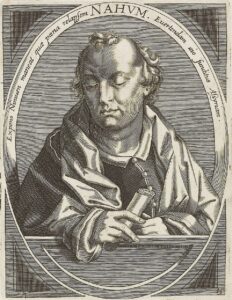
Nahum
Produced c. 1550-1650
Wikimedia, public domain
BY
JIM GERRISH
Unless otherwise indicated, Scripture taken from the HOLY BIBLE, NEW INTER-NATIONAL VERSION® NIV® Copyright © 1973, 1978, 1984, 2011 by Biblica, Inc. All rights reserved worldwide. Used with permission.
Copyright © 2026 Jim Gerrish
Light of Israel Bible Publications
Colorado Springs, CO.
INTRODUCTION
Nahum is yet another mysterious prophet; like several other minor prophets, there is little known about his life outside the text. In the first verse, we will learn that he was an Elkoshite. However, we cannot be at all certain where Elkosh was located. We will discuss some of the problems with this city’s identification later. Nahum prophesied to the Southern Kingdom of Judah (1:15b) since the Northern Kingdom was already in captivity with the Assyrians. The name “Nahum” appears only twice in the Bible (Nah. 1:1 and Luk. 3:25). The name in Hebrew has to do with “comfort” or “compassion.” 1
Regarding the time frame of Nahum’s work, we can be a little more certain. In chapter 3:8-10, we are told about the destruction of No-Amon (Thebes or modern-day Luxor), the capital of Upper Egypt. This destruction took place in 663 BC by the Assyrian King Assurbanipal. Obviously, Nahum had to live sometime after this destruction. From history, we know that Nineveh was destroyed by the Babylonians and the Medes in 612 BC. Nahum’s ministry had to fall between these two dates.2 British Bible scholar Donald Guthrie feels that the ministry of Nahum fell between 621 and 612 BC. 3 That is about as close as we can call it.
Nahum prophesied about Nineveh, the capital city of Assyria. We know from the Bible that Nineveh was founded by Nimrod, who lived shortly after the flood (Gen. 10:8-12). The city is mentioned in the ancient Code of Hammurabi around 2200 BC.4 Nineveh may well have been the largest city in the world. The last verse in the Book of Jonah (4:11) relates that there were more than 120,000 infants in the city. That helps us understand its great size.
James Montgomery Boice, American theologian and religious broadcaster, tells us that the inner city had a wall eight miles in circumference (13 km.). The wall was 100 feet high (30 m.), and it was wide enough that three chariots could race abreast around it.5 In Jonah 3:3, we learn that it took Jonah three days to go through the city.
Nineveh had the distinction of possessing what may be called the oldest library in the world. King Ashurbanipal (660-631 BC) established a collection of over 30,000 cuneiform clay tablets and fragments. These sources dealt with many subjects such as literature, history, medicine, and astronomy. The library was buried in Nineveh’s destruction, and its discovery transformed many of our understandings of the ancient world.
Unfortunately, Nineveh was a very wicked city. The two basic sins of the city were its ruthless military power and its unscrupulous commerce.6 John Phillips, Anglican Bible scholar, remarks that “Nineveh was a monument to tyranny.” 7 Nineveh was so wicked that God had sent the prophet Jonah to her over one hundred years before. At that time, the whole city had deeply repented and was spared. The same would not be true in the prophet Nahum’s time. The great city would be destroyed. Phillips says, “Nineveh vanished into oblivion so completely that for centuries even the place where it had stood was forgotten.” 8 It was only in the 19th century that Nineveh was rediscovered and excavated.
CHAPTER 1
A prophecy concerning Nineveh. The book of the vision of Nahum the Elkoshite. Nahum 1:1
The Hebrew word for prophecy is massa or “burden.” We can only guess at how great the burden of prophecy was that Nahum bore. He had this in common with most of the prophets. It was not just a burden, but it came as a vision. The prophet had seen something in the spiritual world and felt greatly obligated to share this image. It concerned Nineveh, the Assyrian capital city. This was the focus of Nahum’s work. Phillips comments: “Nahum was given the assignment to preach the downfall of Nineveh. A century earlier, Jonah would gladly have given his life for the task.” 1
As we mentioned in the introduction, Nahum was a native of the city of Elkosh. There are various opinions among scholars as to where this city existed. The city of Capernaum on the northwest coast of the Sea of Galilee has been suggested as Nahum’s hometown. Interestingly, Capernaum means “Village of Nahum” in Hebrew. However, there can be no certainty that our Nahum came from that city. Two early Christian writers, Jerome and Eusebius, place the little city of Elkosh in Galilee.2 Several scholars feel that this view has a lot to commend it. Of course, Nahum, who was from Galilee, prophesied to the southern kingdom of Judah.
“The LORD is a jealous and avenging God; the LORD takes vengeance and is filled with wrath. The LORD takes vengeance on his foes and vents his wrath against his enemies” (1:2). The noted F. B. Meyer says of this section: “Nahum 1:1-8 forms a magnificent preamble combining the goodness and severity of God. His dealings with mankind are wrapped in mystery, but he is good and the stronghold of his saints….” 3 Biblical professor Charles L. Feinberg comments: “Nahum’s description of the character of God is unsurpassed for grandeur and majesty.” 4
The prophet begins with an acrostic poem. Verse 2 starts with the first Hebrew letter aleph, verse three begins with the second Hebrew letter beth, and so on through most of the chapter and through the Hebrew alphabet. This was obviously some mnemonic device that was used in Bible times.
We are told of some wonderful and amazing characteristics about the God we serve. He is a jealous God. Jealous and zealous come from the same Hebrew root. Because God is jealous, he is zealous to maintain his covenant, to protect his people, to keep them from worshipping foreign gods. God is zealous to guard and maintain his relationship with his people.
God takes vengeance and exercises wrath upon his enemies. Henry Ward Beecher once said, “A person that does not know how to be angry does not know how to be good.” 5 Thomas Fuller wrote of anger, “He who lacks it has a maimed mind.” 6 There are times when we should be angry. This is called “righteous indignation.” We are to express it when God and his word are abused in our society. This is about the only kind of anger we are allowed to have.
God had every right to be angry at the city of Nineveh. After all, he had warned the city of its evil ways through the ministry of Jonah over a century before. Both prophets spoke of God’s coming judgment. God is coming with great wrath to judge the living and the dead (Isaiah 13:9; 13:13). Hebrews 10:31 says, “It is a dreadful thing to fall into the hands of the living God.”
“The LORD is slow to anger but great in power; the LORD will not leave the guilty unpunished. His way is in the whirlwind and the storm, and clouds are the dust of his feet” (1:3). What a picture of God who is riding on the whirlwind and the storm. If we really believed that God rode on the storm, it would give us a lot more comfort in life’s storms around us. Bob Utley, US Baptist Bible scholar, comments, “‘The Lord is slow to anger.’ This is a key phrase in the description of YHWH’s character, found first in Exod. 34:6-7, and it became a liturgical description of YHWH.” 7 God is slow to anger, but when his anger is kindled, it burns white hot.
It is clear in Scripture that God chose the Assyrians to discipline his people. It is also clear that Assyria went too far (Isa. 10:5ff.). Such a thing happened when God chose Jehu to put an end to evil Ahab’s reign. What resulted was an awful bloodbath of even innocent people.
For one thing, the Assyrians were unbelievably cruel. Phillips describes some of their practices against enemies: “Some had their tongues torn out by the roots. Others were flayed alive; their skins were stretched out on the city walls to terrify any who might entertain ideas of rebellion. Still others were impaled on sharpened spikes and left to scream away their last days and hours in excruciating torment. The kings of Assyria gloated over such torture in their inscriptions.” 8 Assyria would pay dearly for her cruelty.
“He rebukes the sea and dries it up; he makes all the rivers run dry. Bashan and Carmel wither and the blossoms of Lebanon fade” (1:4). Utley says, “Weather awed the ancient world!” 9 The Hebrews were also fascinated by the sea and really almost fearful of it. When the Lord comes in the judgment of the last days, we are told that there will be no more seas (Rev. 21:1). God’s wrath could touch the luscious lands as well. The Bashan, or what is now part of the Golan Heights, was famed for its rich pasturage. Mount Carmel was known for its vineyards, and of course Lebanon was well-known for its rich forests. These would all languish because of God’s wrath (cf. Joel 1:10).
Early British Wesleyan commentator, Adam Clarke, comments: “The description of the coming of Jehovah, from the third to the sixth verse, is dreadfully majestic…If then, the seas, the rivers, the mountains, the hills, the rocks, and the earth itself, fail before Jehovah, or flee from his presence, how shall Nineveh and the Assyrian empire stand before him?” 10
“The mountains quake before him and the hills melt away. The earth trembles at his presence, the world and all who live in it. Who can withstand his indignation? Who can endure his fierce anger? His wrath is poured out like fire; the rocks are shattered before him” (1:5-6). How great and awesome is our God! This description reminds us of God’s appearance on Mt. Sinai as the Ten Commandments were given. “Mount Sinai was covered with smoke, because the LORD descended on it in fire. The smoke billowed up from it like smoke from a furnace, and the whole mountain trembled violently” (Exo. 19:18). We can imagine how much more awesome is the power of God when he comes with indignation. That anger was about to be expressed toward the wicked city of Nineveh.
“The LORD is good, a refuge in times of trouble. He cares for those who trust in him” (1:7). What a contrast we see in God’s nature. The same God who can come with fiery anger upon the wicked can come with comfort and blessing for those who trust in him. The Apostle Paul says of him: “Praise be to the God and Father of our Lord Jesus Christ, the Father of compassion and the God of all comfort, who comforts us in all our troubles, so that we can comfort those in any trouble with the comfort we ourselves receive from God” (2 Cor. 1:3-4).
“But with an overwhelming flood he will make an end of Nineveh; he will pursue his foes into the realm of darkness” (1:8). How accurately this verse describes the end of Nineveh. Christian Church commentator James Burton Coffman defines it, saying: “Without the great and totally unexpected flood that demolished the city wall and opened it up to the invader, it was exceedingly unlikely that the siege of Nineveh would have been successful. Melting snows sent the Tigris and its tributaries into an extraordinarily high flood stage; that was the real ruin of Nineveh, and it was totally of God.” 11 English Bible scholar Peter Pett adds: “Two hundred years later, when Xenophon saw it, it was an unrecognizable mass of debris. And eventually its whereabouts became totally forgotten.” 12
“Whatever they plot against the LORD he will bring to an end; trouble will not come a second time” (1:9). Bible Scholar Robert Jamieson and associates say, “There will be no need of his inflicting on you a second blow: He will make an utter end of you once for all.” 13 God spared Nineveh once in the days of Jonah but he would not do it again.
“They will be entangled among thorns and drunk from their wine; they will be consumed like dry stubble” (1:10). Phillips says, “Speaking derisively, he likened the Assyrians to a bramble bush, a patch of tangled thorns that were harmful but vulnerable to fire.” 14 Thorns are not good for much. They are harmful especially when they are all tangled up. The best solution is to toss the whole mess into the fire. Thorns burn quite well.
It is interesting that when the king of Nineveh saw that all was lost, he gathered his wives, servants, concubines, and himself into a large funeral pyre. They all died in the blaze.15 How true the words of Nahum!
“From you, Nineveh, has one come forth who plots evil against the LORD and devises wicked plans. This is what the LORD says: ‘Although they have allies and are numerous, they will be destroyed and pass away. Although I have afflicted you, Judah, I will afflict you no more. Now I will break their yoke from your neck and tear your shackles away” (1:11-13). The prophet Zephaniah tells us what Nineveh said of herself, “…I am the one! And there is none besides me…” (Zep. 2:15). Pett relates this account: “The story is told of a great man who planned great things. He brought great turmoil on the world, and when challenged by God, cried, ‘And who are you?’ And when his world collapsed, and he lay in his coffin, God quietly bent down and asked, ‘and who are you?’ And closed the lid.” 16
The magnitude of God’s judgment became apparent when Sennacherib tried to invade Jerusalem. In 2 Kings 18:17ff., the Assyrian field commander came to Jerusalem scoffing, ridiculing, and threatening the Jews. It looked like all was lost. But good King Hezekiah trusted in God to keep the city safe. He also trusted in the good words from the prophet Isaiah. “That night the angel of the LORD went out and put to death a hundred and eighty-five thousand in the Assyrian camp. When the people got up the next morning – there were all the dead bodies!” (2 Ki. 19:35). With that awful supernatural defeat, Sennacherib, who had done much to build the Assyrian Empire, quickly fled back to Nineveh. Later he was cut down by his own sons.
“The LORD has given a command concerning you, Nineveh: ‘You will have no descendants to bear your name. I will destroy the images and idols that are in the temple of your gods. I will prepare your grave, for you are vile’” (1:14). Nineveh was a land of idolatry, particularly in the worship of Ishtar. But Nineveh’s idols were doomed. Jamieson says, “The Medes under Cyaxares, the joint destroyers of Nineveh with the Babylonians, hated idolatry, and would delight in destroying its idols.” 17 Not only would her idols disappear, but her people would disappear as well. God would leave Nineveh no natural descendants.
“Look, there on the mountains, the feet of one who brings good news, who proclaims peace! Celebrate your festivals, Judah, and fulfill your vows. No more will the wicked invade you; they will be completely destroyed” (1:15). Here the prophet quotes from Isaiah 52: “How beautiful on the mountains are the feet of those who bring good news, who proclaim peace, who bring good tidings, who proclaim salvation, who say to Zion, ‘Your God reigns!’” This same verse will later be picked up by Paul and used in Romans 10:15. The prophet uses the Hebrew word me-va-ser twice in this verse. It means that they were to bear tidings.
It is interesting that the city of Mevaseret Zion is today located very near the Western entrance of modern Jerusalem. The city’s name in Hebrew means “herald to Zion.” It is doubly interesting that many evangelical Christians live in this city, and they have the delightful task of being heralds of the gospel message to God’s dear people, the Jews. Indeed, they have truly beautiful feet on the mountains of Israel.
CHAPTER 2
An attacker advances against you, Nineveh. Guard the fortress, watch the road, brace yourselves, marshal all your strength! Nahum. 2:1
Coffman, quoting Alexander Fraser, says, “In the remaining two chapters, he turns to his subject in particular and in detail, setting forth its accomplishment in word-pictures of battle, unrivalled in Hebrew literature.” 1 Boice comments, “This chapter is a masterpiece of ancient literature, unsurpassed for its graphic portrayal of a military assault.” 2
We need to realize that ancient sieges were terrible things. Defenders were locked inside the city where they often starved or died of disease. The siege of Nineveh was short and was carried on for only three months. The Babylonians led by Nabopolassar and the Medes led by Cyaxares were the main opponents. Some smaller contingents like the Scythians and Cimmerians were also involved in the siege. It appears that many people wanted to get their vengeance upon the cruel and hated Assyrians.
Phillips notes that Nineveh’s suburbs were already full of enemy troops, with the city’s massive walls and towers surrounded by troops. Unfortunately for the invaders, there were walls within the defensive wall, and the main city was virtually impregnable.3
“The LORD will restore the splendor of Jacob like the splendor of Israel, though destroyers have laid them waste and have ruined their vines” (2:2). Nahum is clear that it is God who will be fighting this battle. It seems that the Lord pauses to remember both Israel and Judah, who had been devastated by the Assyrians. Of course, the ten tribes of Israel were carried away soon after the Assyrian invasion of Israel in 722 BC. The Assyrians had done much damage to Judah as well. The walled fortress of Lachish was conquered, along with Debir and many other cities in Judah. However, because of an incredible miracle, Jerusalem was spared. Here the Lord vows to restore his people.
“The shields of the soldiers are red; the warriors are clad in scarlet. The metal on the chariots flashes on the day they are made ready; the spears of juniper are brandished” (2:3). We almost have to stop in amazement at the prophet’s detailed description of this great battle that was yet to come. The prophet is likely describing the Babylonians and Medes here. The Greek writer Xenophon claimed that red was a favorite color of the Medes.4 Utley says, “We know from Assyrian documents that the Assyrians and Babylonians both used red shields and cloaks.” 5 The prophet even foresees the sun flashing on the metal of the chariots so that they appear to be aflame. He also sees the soldiers waving their juniper spears as they threaten their enemies.
“The chariots storm through the streets, rushing back and forth through the squares. They look like flaming torches; they dart about like lightning” (2:4). In ancient times the chariot was a fearful thing. It might even be compared to the battle tank of our day. Pett more fully describes this scene: “The enemies have breached the outer defenses outside the walls, their chariots race through the suburban streets, jostling in their hurry to get at the foe.” 6 This chariot display must have struck terror in the hearts of the Ninevites.
“Nineveh summons her picked troops, yet they stumble on their way. They dash to the city wall; the protective shield is put in place” (2:5). Bible scholar and broadcaster, Warren Wiersbe, says, “He gathers his best officers and gives them orders to protect the wall, but they are so late. They stumble like drunks instead of marching like heroes.” 7 The word for “protective shield” is mantelet. Bible scholars have never been sure what this word is describing. Pfeiffer & Harrison say, “It was some form of movable protection, under cover of which the defenders could make ready their counterthrust.” 8
THE BATTLE AND THE RIVER
The river gates are thrown open and the palace collapses. Nahum 2:6
We do not know exactly how or why the river gates were thrown open. Jamieson says, “The river wall on the Tigris (the west defense of Nineveh) was 4,530 yards long. On the north, south, and east sides, there were large moats, capable of being easily filled with water from the Khosru.” 9
Clarke fills us in on some of the history or legend. “The account given by Diodorus Siculus, lib. ii., is very surprising. He begins thus … ‘There was a prophecy received from their forefathers, that Nineveh should not be taken till the river first became an enemy to the city. …that the Euphrates [query, Tigris] being swollen with continued rains, overflowed part of the city, and threw down twenty stadia of the wall.” 10 When we remember that the great city was built with sun-dried blocks, we can understand how they might simply have dissolved with the flooding. So apparently, a large section of the wall collapsed along with the palace.
Boice gives us more information. “At this point, the king, Sardanapalus, remembering an oracle to the effect that Nineveh would only fall when the river itself declared war against it, believed that the oracle was fulfilled and abandoned any hope of saving himself. He built a gigantic funeral pyre in the royal precincts, heaped up large quantities of gold and costly clothes, shut his concubines and eunuchs in a chamber he had made in the midst of the pyre, and then burned himself, his family, his concubines and eunuchs, and the palace.” 11 Boice continues, “The agreement between Nahum’s prophecy and the details of Nineveh’s fall are so great that some unbelieving commentators have declared it a vaticinium ex eventu ( a “prophecy” made after the event).” 12
“It is decreed that Nineveh be exiled and carried away. Her female slaves moan like doves and beat on their breasts” (2:7). What a sad and tragic picture of conquest and exile. Yet, Assyrian armies had done the same thing to helpless people throughout their history. In the Hebrew, this sentence begins with the mysterious name Huzzab. Scholars have thought that this might be the queen of Nineveh with her female attendants. Others have suggested that it was Ishtar, the main Assyrian goddess with all her “holy” prostitutes. The puzzling thing is that “No queen of Nineveh is known by the name, nor an Assyrian goddess.” 13 Utley does comment: “…Assyrian records show they paraded conquered Queens naked through the streets of their capital.” 14 The sound of pigeons and doves was taken as the sound of grief and mourning.
“Nineveh is like a pool whose water is draining away. ‘Stop! Stop!’ they cry, but no one turns back” (2:8). Everywhere there was the picture of water since water actually brought about the downfall of the great city. Apparently, there were attempts to rally the troops, all in vain. All were fleeing for their lives. Feinberg says, “Flight is uppermost in every mind; commands fall on deaf ears.” 15
“Plunder the silver! Plunder the gold! The supply is endless, the wealth from all its treasures! She is pillaged, plundered, stripped! Hearts melt, knees give way, bodies tremble, every face grows pale” (2:9-10). Coffman says, “Looting is the same in all ages and countries. The looting of Assyria is taking place in this verse; and no people who ever lived on earth knew any more about looting than the Assyrians; but now it was their turn to be the looted!” 16
Nineveh had become “filthy rich.” Not only had she looted numerous kingdoms but she had collected great amounts of tribute from her many subject states. Now all that wealth would be carried away. Boice says, “The royal reports of Nineveh speak again and again of its immeasurable wealth…It is an impressive confirmation of this prophecy that nothing of all this gold and silver has been discovered in the ruins of Nineveh by archaeologists. Nineveh was indeed stripped bare.” 17
We can hardly imagine the horror felt by the residents. Their faces were all pale, with their knees knocking and hearts melting.
“Where now is the lions’ den, the place where they fed their young, where the lion and lioness went, and the cubs, with nothing to fear? The lion killed enough for his cubs and strangled the prey for his mate, filling his lairs with the kill and his dens with the prey” (2:11-12). The lion was one important emblem of the Assyrian Empire. They crushed many empires like a lion would crush its prey.18
Coffman comments: “Due to the remains of animals killed for prey, with leftovers decaying as new prey is brought in, a lion’s den is positively the foulest and most detestable place on earth, an apt figure indeed of the Assyrian capital…” 19 Such was the Assyrian Empire.
WHEN GOD IS AGAINST A NATION
“I am against you,” declares the LORD Almighty. “I will burn up your chariots in smoke, and the sword will devour your young lions. I will leave you no prey on the earth. The voices of your messengers will no longer be heard.” Nahum 2:13
Biblical author and pastor David Guzik says, “Behold, I am against you: What a terrible thing to hear from God!” 20 We know from Romans 8:31, “… If God is for us, who can be against us?” However, the reverse is also the case: “If God is against us, who can be for us?” Fraser says, “Of all the empires, Nineveh was the one most unashamedly founded upon force and cruelty.” 21 God could not let such a wicked kingdom continue on earth.
Just as there are evil kingdoms even today, there is also a righteous kingdom, and that, of course, is the Kingdom of God. That kingdom is coming, and by faith in Jesus we can all be members of this kingdom. It is hard to imagine, but the whole earth then will be full of the knowledge and glory of the Lord as waters cover the sea (Hab. 2:14).
CHAPTER 3
Woe to the city of blood, full of lies, full of plunder, never without victims! The crack of whips, the clatter of wheels, galloping horses and jolting chariots! Nahum 3:1-2
Boice comments: “When Nahum calls Nineveh a ‘city of blood,’ his words are a massive understatement. In all the ancient world, no single city had matched the Assyrian capital for its calculated cruelty.” 1 Many atrocities are pictured in Nineveh’s inscriptions. As mentioned, they stretched the skins of their enemies on the city walls; they impaled their prisoners on stakes; they cut off limbs; they burned thousands alive in the fire; they cut off fingers, noses, ears, and put out the eyes of their enemies. They beheaded many and hung their heads around the city.2 Pfeiffer says, “Nineveh was founded and maintained on murder, bloodshed, and constant warfare…truce-breaking was all too common. Extortion and violence were the order of the day…The later history of Assyria is one of almost uninterrupted warfare.” 3
Pett brings all this up to the present, saying: “This could describe many of our modern cities today, their lives a constant pretense and show, their wealth built on the poverty of others. Why should their inhabitants escape the fate of Nineveh?” 4
Amazingly, the prophet could clearly see and perceive all this. He could even hear the whips cracking, the chariot wheels clattering, and the horses galloping in this future battle. It is like an eyewitness account of the city’s destruction. Guthrie says, “These verses are a superlative example of Nahum’s powers of description, and form one of the most vivid battle scenes in Hebrew literature.” 5 We have to conclude that Nahum has some of the clearest prophecies in all of Scripture.
“Charging cavalry, flashing swords and glittering spears! Many casualties, piles of dead, bodies without number, people stumbling over the corpses – all because of the wanton lust of a prostitute, alluring, the mistress of sorceries, who enslaved nations by her prostitution and peoples by her witchcraft” (3:3-4). “Archaeologists have confirmed that the people of Nineveh practiced witchcraft…Hundreds of sorcery incantations have been brought to light.” 6 Nahum continues with his very accurate prophetic description. There will be swords, spears, and piles of the dead. People will even be stumbling over dead bodies.
Utley says, “The Assyrian king, Shalmaneser III, boasted of erecting a pyramid of chopped-off heads in front of an enemy’s city. Other Assyrian kings stacked corpses like cord wood by the gates of defeated cities.’ What they did to others has now come home to them.” 7
The shedding of innocent blood was a serious matter as we see in many Scriptures (Deut. 19:11-13; 2 Ki. 21:16; 24:4; Psa. 106:38; Prov. 6:16-17; Isa. 59:7). The shedding of blood brings a curse upon the ground (Gen. 4:9-12). With much innocent bloodshed in the US, we can understand why we are now beginning to have problems with our farming.
Nineveh abounded with idols. Phillips says, “And gross immorality always accompanies idolatry.” 8 The lure of sexual immorality was no doubt one of the big reasons why idolatry flourished throughout the ancient world and even in Israel. Wiersbe says, “People become like the god that they worship (Psa. 115:8), for what we believe determines how we behave.” 9 Numerous were the ancient temples that offered sacred prostitutes for their worship. Ishtar was the patroness of sex. “She had offered occult practices, sexual perversion, false religion, political favor and indecent wealth in a poor and struggling world.” 10
“‘I am against you,’ declares the LORD Almighty. ‘I will lift your skirts over your face. I will show the nations your nakedness and the kingdoms your shame. I will pelt you with filth, I will treat you with contempt and make you a spectacle’” (3:5-6). Nahum is repeating the curse he had first mentioned in 2:13. What can a person or nation do when the Almighty God is against them?
We seem to have some ancient punishments mentioned here. Clarke says, “It was an ancient, though not a laudable custom, to strip prostitutes naked, or throw their clothes over their heads, and expose them to public view, and public execration. This verse alludes to such a custom.” 11
God does declare that he will bring all secret things into judgment (Eccl. 12:14). We see that prostitutes or those caught in adultery in the Bible were sometimes treated this way (Jer. 13: 22, 26; Ezek. 16:36-37; Hos. 2:3, 8-9). However, in Assyria’s custom this was often the method of treating female captives.12
Clarke further describes their shameful practices: “They put such women in the pillory as a gazing-stock; and then, children and others threw mud, dirt, and filth of all kinds at them.” 13 Nineveh was about to become a gazing-stock for all of the nations.
“All who see you will flee from you and say, ‘Nineveh is in ruins – who will mourn for her?’ Where can I find anyone to comfort you?” (3:7). Historical records indicate that thousands of people fled Nineveh. So many of the people and leaders fled that they were able to found a new, temporary capital at Haran. That capital did not last. No one had time to mourn since all were escaping for their lives.
THEBES, AN EARLY PICTURE OF NINEVEH’S FALL
Are you better than Thebes, situated on the Nile, with water around her? The river was her defense, the waters her wall. Nahum 3:8
Thebes, or No-Amon in the Hebrew, was also a great city. It was the capital city of southern Egypt. Phillips says, “The might of all Egypt and Ethiopia was concentrated at Thebes.” 14 Like Nineveh, Thebes was also located around water. Thebes was a greatly fortified city. “The important Greek poet Homer spoke of it as having one hundred gates.” 15 Not only was it greatly fortified, but Thebes had many friends and allies, while Nineveh had none that were faithful. Thebes was the great capital city of the Pharaohs of the Eighteenth to the Twentieth Dynasties.16 Nevertheless, the Assyrians under Ashurbanipal captured and destroyed the city in 663 BC.
The ruins of Thebes with all its gigantic monuments are a prime tourist attraction in Egypt today. Thebes was Egypt’s great religious center honoring the solar god Amon. The city was home to some of the world’s greatest monuments honoring the dead, the living, and the divine.
Like Nineveh, the overthrow of Thebes was also foretold in Scripture (Jer. 46:25 and Ezek. 30:14-16). Thebes, like Nineveh, was also weakened by idolatry. The Egyptians had all kinds of gods, including cows, cats, and crocodiles.17
“Cush and Egypt were her boundless strength; Put and Libya were among her allies. Yet she was taken captive and went into exile. Her infants were dashed to pieces at every street corner. Lots were cast for her nobles, and all her great men were put in chains” (3:9-10). We remember that it was customary for the Assyrians to remove and replace populations of captured nations. Since babies and small children could not travel well, they were simply murdered, and that in a very cruel manner. Leaders were humiliated and chained together like animals. Many times, rings or hooks were put in their noses. In 2 Chronicles 33:1, captured King Manasseh was treated in just this fashion by the Babylonians.
“You too will become drunk; you will go into hiding and seek refuge from the enemy” (3:11). Nahum, with his unique gift of prophecy, could see that Nineveh would follow the path of Thebes. She would be destroyed, and her people would go into hiding. However, Nineveh would never be a tourist site. Nineveh would be buried in the dust and lost for the many centuries to come.
PICTURES OF WEAKNESS
All your fortresses are like fig trees with their first ripe fruit; when they are shaken, the figs fall into the mouth of the eater. Look at your troops – they are all weaklings. The gates of your land are wide open to your enemies; fire has consumed the bars of your gates.” Nahum 3:12-13
Clarke says, “the first-ripe figs, when at full maturity, fell from the tree with the least shake; and so, at the first shake or consternation, all the fortresses of Nineveh were abandoned.” 18 All this reminds us of Isaiah’s description of the day of the Lord: “Wail, for the day of the LORD is near; it will come like destruction from the Almighty. Because of this, all hands will go limp, every heart will melt with fear. Terror will seize them, pain and anguish will grip them; they will writhe like a woman in labor. They will look aghast at each other, their faces aflame” (Isa. 13:6-8). A similar thing would one day happen to mighty Babylon. “Babylon’s warriors have stopped fighting; they remain in their strongholds. Their strength is exhausted; they have become weaklings. Her dwellings are set on fire; the bars of her gates are broken” (Jer. 51:30).
“Draw water for the siege, strengthen your defenses! Work the clay, tread the mortar, repair the brickwork!” (3:14). A good water supply was an absolute necessity for a long siege. We sense that Nineveh is almost in a panic mode with their preparations. We also sense that their defense efforts are much too late.
Clarke describes the manner of making bricks. He says, “They dug up the clay, kneaded it properly by treading, mixed it with straw or coarse grass, molded the bricks, and dried them in the sun… They are compact and very hard, but wholly soluble in water.” 19 It was the water, floods of it, that would bring down a large section of the wall and allow access to the enemy.
“There the fire will consume you; the sword will cut you down – they will devour you like a swarm of locusts. Multiply like grasshoppers, multiply like locusts!” (3:15). There is much historical evidence that Nineveh was completely burned. We spoke earlier about how the king and his companions constructed a funeral pyre and burned themselves to death. Really, the whole city was burned. Guzik notes: “The excavators of Nineveh have remarked on the large deposits of ash, which are evidence of a gigantic conflagration.” 20 Feinberg adds, “Ancient historians indicate that Nineveh was destroyed by fire, and modern findings confirm it.” 21 Phillips remarks, “God always rewards apostasy with catastrophe.” 22 Nineveh’s many enemies would act like a swarm of locusts and devour everything before them.
“You have increased the number of your merchants till they are more numerous than the stars in the sky, but like locusts they strip the land and then fly away” (3:16). Nineveh was astride a great caravan route with the Tigris River giving access to the sea. The wealth of nations flowed through her and also the merchants flocked to the city.23 Unfortunately, the merchants were most interested in fleeing with their wealth and not in defending the city. “So the men who were attracted to Nineveh by self-interest will take flight in every direction, when her evil day comes.” 24
“Your guards are like locusts, your officials like swarms of locusts that settle in the walls on a cold day – but when the sun appears they fly away, and no one knows where” (3:17). It seems that Nahum could not get the picture of locusts out of his mind. Now he calls the guards locusts. They cling to the walls like locusts might do on a cold day. Then when they have the opportunity, they flee away from their posts. Utley says, “Grasshoppers are immobile in cold weather, and this was a striking metaphor for Nahum’s purposes.” 25
“King of Assyria, your shepherds slumber; your nobles lie down to rest. Your people are scattered on the mountains with no one to gather them. Nothing can heal you; your wound is fatal. All who hear the news about you clap their hands at your fall, for who has not felt your endless cruelty?” (3:18-19). Nineveh was such a wicked city that with her fall people everywhere clapped their hands in glee. There was no hope for the city, just as there would be no hope for wicked cities in the future. As Psalm 73:19 says, “How suddenly are they destroyed, completely swept away by terrors!” It is said of him in Psalm 9:5, “You have rebuked the nations and destroyed the wicked; you have blotted out their name for ever and ever.”
In all his actions God’s name is to be praised. While God destroys the wicked, he saves and protects the obedient, whether it be nations or individuals. May we learn that lesson well in the story of Nineveh.
ENDNOTES
Several sources I have cited here are from the electronic media, either from websites or from electronic research libraries. Thus, in some of these sources, it is not possible to cite page numbers. Instead, I have cited the verse or verses in Nahum (e.g. v. verse 1:1 or vs. verses 1:5-6) about which the commentators speak.
We highly recommend watching the following two excellent videos on the fall of Nineveh. These will prepare you for a much fuller understanding of Nahum.
The Rise and Fall of Nineveh: https://www.google.com/search?q=videos+of+fall+of+nineveh
19.23 min
Life in Nineveh: The Cruelest City on Earth Before Destruction https://www.youtube.com/watch?v=eIomxIWFBsY 46.20 min.
INTRODUCTION
1 Bob Utley, Free Bible Commentary, Nahum, Int. https://www.freebiblecommentary.org/old_testament_studies/VOL10BOT/VOL10BAOT_introduction.html
2 James Burton Coffman, Coffman’s Commentaries on the Bible, Commentary on Nahum (Abilene, TX., Christian University Press, Intro.,1983-1999). https://www.studylight.org/commentaries/eng/bcc/nahum-1.html.
3 D. Guthrie, J.A. Motyer, A.M. Stibbs, D. J. Wiseman, The New Bible Commentary: Revised (Grand Rapids: Wm. B. Eerdmans Publishing Co., 1970), p. 762.
4 James Montgomery Boice, The Minor Prophets, Vol. 2 (Grand Rapids: Baker Books, 1986), 370.
5 Ibid., p. 371.
6 D. Guthrie, et. al., The New Bible Commentary: Revised, p. 762.
7 John Phillips, Exploring The Minor Prophets (Grand Rapids: Kregel Publications, 1998), p. 184.
8 Ibid., p. 186.
CHAPTER 1
1 Phillips, Exploring The Minor Prophets, p. 185.
2 Utley, Free Bible Commentary, Nahum, v. 1:1f.
3 F. B. Meyer, Meyer’s Commentary, Nahum, v. 1:1-15.
https://www.studylight.org/commentaries/eng/fbm/nahum.html
4 Charles L. Feinberg, The Minor Prophets (Chicago: Moody Publishers, 1990), p. 189.
5 Quoted in Warren W. Wiersbe, The Wiersbe Bible Commentary, OT (Colorado Springs: David C. Cook, 2007), p. 1464.
6 Ibid.
7 Utley, Free Bible Commentary, Nahum, v. 1:3.
8 Phillips, Exploring The Minor Prophets, p. 185.
9 Utley, Free Bible Commentary, Nahum, v. 1:1f.
10 Adam Clarke, The Adam Clarke Commentary, Commentary on Nahum, 1832, v. 1:4. https://www.studylight.org/commentaries/eng/acc/nahum-1.html.
11 Coffman, Coffman’s Commentaries on the Bible, Commentary on Nahum, v. 2:6.
12 Peter Pett, Pett’s Commentary on the Bible, Commentary on Nahum, 2013, v. 1:8. https://www.studylight.org/commentaries/eng/pet/nahum-1.html.
13 Robert Jamieson; A.R. Fausset, & David Brown, Commentary Critical and Explanatory on the Whole Bible, Commentary on Nahum, 1871, v. 1:9. https://www.studylight.org/commentaries/eng/jfb/nahum-1.html.
14 Phillips, Exploring The Minor Prophets p. 189.
15 Coffman, Coffman’s Commentaries on the Bible, Commentary on Nahum, v. 1:10.
16 Pett, Pett’s Commentary on the Bible, Commentary on Nahum, vs. 1:11-13.
17 Jamieson, Fausset, & Brown, Commentary Critical and Explanatory on the Whole Bible, Commentary on Nahum, v. 1:4.
CHAPTER 2
1 Quoted in Coffman, Coffman’s Commentaries on the Bible, Commentary on Nahum, v. 2:1ff.
2 Boice, The Minor Prophets, Vol. 2, p. 376.
3 Phillips, Exploring The Minor Prophets, p. 192.
4 Charles F. Pfeiffer & Everett F. Harrison, The Wycliffe Bible Commentary (Chicago: Moody Press, 1979), p. 866.
5 Utley, Free Bible Commentary, Nahum, v. 2:3.
6 Pett, Pett’s Commentary on the Bible, Commentary on Nahum, v. 2:4.
7 Wiersbe, The Wiersbe Bible Commentary, OT, p.1465.
8 Pfeiffer & Everett F. Harrison, The Wycliffe Bible Commentary, p. 866.
9 Jamieson, Fausset, & Brown, Commentary Critical and Explanatory on the Whole Bible, Commentary on Nahum, v. 2:6.
10 Quoted in Clarke, The Adam Clarke Commentary, Commentary on Nahum, v. 2:6.
11 Boice, The Minor Prophets, Vol. 2, pp. 376-377.
12 Ibid., p. 378.
13 Pfeiffer & Harrison, The Wycliffe Bible Commentary, p. 867.
14 Utley, Free Bible Commentary, Nahum, v. 2:7.
15 Feinberg, The Minor Prophets, p. 195.
16 Coffman, Coffman’s Commentaries on the Bible, Commentary on Nahum, v. 2:9.
17 Boice, The Minor Prophets, Vol. 2, p. 377.
18 David Guzik, Enduring Word Bible Commentary, Nahum, vs. 2:8-12.
19 Coffman, Coffman’s Commentaries on the Bible, Commentary on Nahum, v. 2:12.
20 Guzik, Enduring Word Bible Commentary, Nahum, v. 2:13.
21 Quoted in Coffman, Coffman’s Commentaries on the Bible, Commentary on Nahum, v. 2:1f
CHAPTER 3
1 Boice, The Minor Prophets, Vol. 2, p. 381.
2 Ibid., pp. 381-382.
3 Pfeiffer & Harrison, The Wycliffe Bible Commentary, p. 867.
4 Pett, Pett’s Commentary on the Bible, Commentary on Nahum, vs. 3:1-3.
5 Guthrie, et. al., The New Bible Commentary: Revised, p. 765.
6 Boice, The Minor Prophets, Vol. 2, p. 382.
7 Utley, Free Bible Commentary, Nahum, v. 3:3.
8 Phillips, Exploring The Minor Prophets, p. 195.
9 Wiersbe, The Wiersbe Bible Commentary, OT, p.1466.
10 Pett, Pett’s Commentary on the Bible, Commentary on Nahum, v. 3:4.
11 Clarke, The Adam Clarke Commentary, Commentary on Nahum, v. 3:5.
12 Quoted in Coffman, Coffman’s Commentaries on the Bible, Commentary on Nahum, v. 3:5.
13 Clarke, The Adam Clarke Commentary, Commentary on Nahum, v. 3:6.
14 Phillips, Exploring The Minor Prophets, p. 196.
15 Pfeiffer & Harrison, The Wycliffe Bible Commentary, p. 868.
16 Feinberg, The Minor Prophets, p. 199.
17 Phillips, Exploring The Minor Prophets, p. 196.
18 Clarke, The Adam Clarke Commentary, Commentary on Nahum, v. 3:12.
19 Ibid., v. 3:14.
20 Quoted in Guzik, Enduring Word Bible Commentary, Nahum, vs. 3:12-15.
21 Feinberg, The Minor Prophets, p. 201.
22 Phillips, Exploring The Minor Prophets, p. 199.
23 Ibid., p.198.
24 Guthrie, et. al., The New Bible Commentary: Revised, p. 766.
25 Utley, Free Bible Commentary, Nahum, v. 3:17.