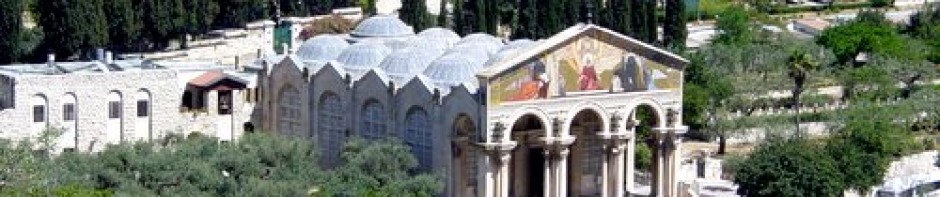
HABAKKUK: HAGGLING WITH GOD
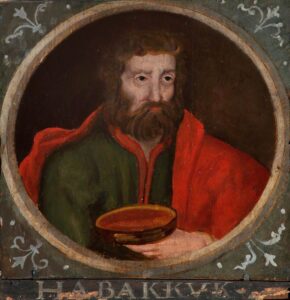 The Prophet Habakkuk
circa 1610 and 1615
UK National Trust
Public Domain
by
JIM GERRISH
Unless otherwise indicated, Scripture taken from the HOLY BIBLE, NEW INTER-NATIONAL VERSION® NIV® Copyright © 1973, 1978, 1984, 2011 by Biblica, Inc. All rights reserved worldwide. Used with permission.
Copyright © 2026 Jim Gerrish
Light of Israel Bible Publications
Colorado Springs, CO.
INTRODUCTION
The only thing we know about Habakkuk is his name. He has this in common with the other Minor Prophets of Obadiah and Malachi. His name in Hebrew means “The Embracer.” The Bible scholars, Pfeiffer & Harrison, say this name means that he loved God or else that he wrestled with God.1 Bob Utley, US Baptist Bible scholar, comments, “The first literary unit (Hab. 1:2-2:5) is a diatribe or a means of communicating truth through dialogue. It is very unusual for a prophet to speak to God on behalf of the people. Usually, prophets speak for God to the people.” 2 British scholar Donald Guthrie says, “Habakkuk is the first prophet to arraign not Israel but God.” 3
Some Bible scholars have felt that Habakkuk was a Levite. Either that, or he may have been a member of the professional guild of prophets attached to the Temple (1 Chr. 25:1).4 They have felt this way because of the musical and poetic arrangement of chapter 3, particularly regarding the last verse of the book.5
We can be a little more certain regarding the time frame in which Habakkuk was written. It was written around the timing of some of history’s most important battles. Assyria was still the dominant power in the Middle East; however, that power was quickly declining. No doubt, people would have laughed when Habakkuk named Babylon as the future conqueror of Judah.
The great Battle of Nineveh in 612 BC signaled the end of Assyria and the future rise of Babylon. The battle of Carchemish in 605 BC made that a fact. Assyria was no more, and Nebuchadnezzar’s Neo-Babylonian kingdom ruled the world. “The indication is clear that Habakkuk ministered at a time when the Chaldeans were coming to the fore in world politics.” 6
In that same year of 605 BC, Nebuchadnezzar made his first attack on Jerusalem. Habakkuk was probably written toward the end of King Josiah’s reign (640-609 BC), likely after the destruction of Nineveh. It was certainly written before 605 BC.7 In that era, Habakkuk would have had much prophetic companionship with Daniel, Jeremiah, Ezekiel, Nahum, and Zephaniah.8
Habakkuk lodged a complaint to God and waited for an answer. The answer he got only raised more complaints to God. Despite his disagreements with the Lord, Feinberg says, “All concede to Habakkuk a very high place among the Hebrew prophets. The poetry of chapter 3 has been rightly accredited on every hand as the most magnificent Hebrew poetry.” 9
CHAPTER 1
The prophecy that Habakkuk the prophet received. How long, LORD, must I call for help, but you do not listen? Or cry out to you, “Violence!” but you do not save? Habakkuk 1:1-2
Habakkuk probably spent his boyhood during the reign of good King Josiah and the great revival of religion that happened during his tenure. But King Josiah was killed in the battle leading up to Carchemish. Apparently, the revival had a shallow effect. Very quickly, disillusionment set in, and Judah returned to her old evil ways. The prophet was appalled.
He often cried out to God in prayer, but it did not seem that the Lord was listening to him. He cried concerning the outright violence going on in the midst of the “holy” people, but God did not seem interested. His prayers were much like the psalmist who lamented, “My God, I cry out by day, but you do not answer, by night, but I find no rest” (Psa. 22:2). The word “prophecy” is the Hebrew masa, and it has the meaning of “load” or “burden.” The prophet was weighed down with it.
We have had several great revivals in the US, with the largest and most recent one being the Charismatic Renewal of the 1960s through the 1980s. Many lives were changed in all denominations; however, the holy fire of that movement seems to have mostly dissipated. Many, and hopefully most, Christians have cried out to God about the wickedness now going on even in our so-called “Christian” countries.
We see hardened criminals being turned back out on the streets by our liberal judges and courts. We watch in dismay as sound biblical laws are spurned. We see homes wrecked with adultery. It seems that our citizens can no longer talk without dropping “F bombs” with every other breath. Their public speeches are often almost a series of bleeps. Are we crying to God as Habakkuk did? Do we keep on moaning in our prayers? James Montgomery Boice, American theologian and broadcaster, comments, “Habakkuk is so eminently contemporary. For a book written in Judah more than 2,500 years ago, it deals with surprisingly modern problems.” 1
Utley mentions several of the things that were grieving Habakkuk. There was destruction (1:3), violence (1:3; 2:8,17), strife (1:3), contention (1:3), ignoring of the law (1:4); justice not upheld (1:4); the wicked surrounded the righteous (1:4); and justice was perverted (1:4).2 In addition, the courts were corrupt, and the wealthy abused the poor and needy.
The early Christian father, Theodore of Mopsuestia (350-428 AD) commented, “Blessed David also says in like manner, ‘Why, O Lord, do you keep your distance? Why do you look down on us in good times and in bad?’ When the godless act disdainfully, the poor person is inflamed” (Psa. 11:1).3 Both David and Jesus cried out, “My God, my God, why have you forsaken me?” (Psa. 22:1; Matt. 27:46).
“Why do you make me look at injustice? Why do you tolerate wrongdoing? Destruction and violence are before me; there is strife, and conflict abounds” (1:3). H. A. Ironside said years ago, “True followers of the Lord are in danger of being unduly depressed and disheartened by the rising power of the mystery of iniquity.” 4 Even the most steadfast believers have to cry out at times, “God, where are you? God, why don’t you do something?” Habakkuk boldly charged God with tolerating wrongdoing. Both Habakkuk and some believers today forget that our Lord is a God of patience and long suffering (Psa. 86:15; 2 Pet. 3:9).
“Therefore the law is paralyzed, and justice never prevails. The wicked hem in the righteous, so that justice is perverted” (1:4). In Habakkuk’s time, there was much lawlessness, and the law was of no effect. At that time, Jeremiah was almost murdered for declaring the word of the Lord to the people (Jer. 26:1ff.). In every generation, Satan seems to have as his target the doing away with the law, both natural law and biblical law.
When I was in grade school long ago, it was not uncommon for the Ten Commandments to be posted in the public school classrooms. Indeed, the commandments were a fixture in public education. The command, “Thou shalt not kill,” was there for all students to see. All this changed with the landmark 1980 Stone v. Graham case in the US Supreme Court. This ruling was supposedly based on the US First Amendment Establishment Clause, prohibiting public schools from endorsing or establishing any religion. It is amazing that when the command “Thou shalt not kill” was removed, the schools became very unsafe places. Students started killing each other as well as their teachers and outsiders.
Now, one of America’s pressing problems is the matter of school shootings. At the beginning of the 21st Century, they were running at about 5 total per year, with about 5 killed and a similar number injured in the events. However, by 2025, they were running at 68 per year, with a total of 36 killed in all events and 109 wounded.5 Everywhere in our society, there is a rise in lawlessness. The New Testament tells us that eventually the whole world will be ruled by the Lawless One, the Antichrist (2 Thess. 2:8; 1 John 2:18; Rev. 19:19). American theologian Albert Barnes says, “Sin produces sin, and wrong produces wrong; it spreads like an infectious disease, propagating itself, and each, to whom it reaches, adds to its poison.” 6 Jesus warns us, “Because of the increase of wickedness, the love of most will grow cold, but the one who stands firm to the end will be saved” (Matt. 24:12-13).
GOD ANSWERS
Look at the nations and watch – and be utterly amazed. For I am going to do something in your days that you would not believe, even if you were told. Habakkuk 1:5
What a statement from God! It is one that could keep people up at night, wondering what God was up to. God was about to bring the Babylonians against his own people. At this time, the world’s power was the Assyrians. Babylon had not yet set foot in Judah and was not considered the enemy. Interestingly, the Apostle Paul used this verse against the unbelieving Jews of Pisidian Antioch in Acts 13:41.
We have no idea what the prophet was expecting God to do. Perhaps he thought God would send another great revival like the one in the days of Josiah.7 The days of revival were over, and the day of judgment was about to dawn for Judah.
“I am raising up the Babylonians, that ruthless and impetuous people, who sweep across the whole earth to seize dwellings not their own. They are a feared and dreaded people; they are a law to themselves and promote their own honor” (1:6-7). Much like their predecessors, the Assyrians, the Babylonians were a ruthless and cruel people. As in the case of Daniel, we know they fed prisoners to lions. From their wall engravings, we know they chained prisoners neck to neck, tortured them, and enslaved them.
“Their horses are swifter than leopards, fiercer than wolves at dusk. Their cavalry gallops headlong; their horsemen come from afar. They fly like an eagle swooping to devour; they all come intent on violence. Their hordes advance like a desert wind and gather prisoners like sand” (1:8-9). Theologian A. R. Faussett says of the leopard, “It runs most swiftly straight on: you would fancy it was flying through the air.” 8 Although the Leopard is not the fastest attack animal, it still reaches the impressive speed of 55 mph, or 88.5 km.9 Adam Clarke, quoting Oppian, says of Euphrates horses, “They are by nature warhorses, and so intrepid that neither the sight nor the roaring of the lion appalls them; and, besides, they are astonishingly fleet.” 10
“They mock kings and scoff at rulers. They laugh at all fortified cities; by building earthen ramps they capture them. Then they sweep past like the wind and go on – guilty people, whose own strength is their god” (1:10-11). Well-known Bible scholar and broadcaster Warren Wiersbe tells how they put defeated kings into cages and exhibited them like animals.11 Feinberg comments: “In this section of the prophecy, we have had described for us in a remarkable pen portrait of the Chaldean invader, his nature, manner of operation, purpose, weapons, attitude toward others, and the basic cause of his ultimate downfall.” 12
HABAKKUK COMPLAINS AGAIN
LORD, are you not from everlasting? My God, my Holy One, you will never die. You, LORD, have appointed them to execute judgment; you, my Rock, have ordained them to punish. Habakkuk 1:12
Boice comments, “Habakkuk faced a situation in which a most ungodly nation, Babylon, was going to be used to judge Israel, God’s special people. Habakkuk cries out, ‘Wait! Wait! Hold on just a minute!’” 13 Pastor and commentator David Guzik adds: “It would be like crying out to God about the state of the church in America, and hearing God respond by saying, ‘I’ll fix the problem by an enemy invasion of America.’ We might say, ‘Wait a minute, LORD – the problem is bad, but Your cure is worse than the disease!’” 14 How can a holy God use such vile and unholy instruments?
God knows what he is doing, and he just wants his people to trust him. God holds all history in his hand, and he turns it the way that pleases him. We see in Scripture that God used Assyria as his razor (Isa. 7:20) and Babylon as his battle axe (Jer. 51:20-21). He uses all nations as he pleases to work out his eternal plan. He then judges their wickedness (Jer. 51:24). Boice comments, “History follows a divine timetable…history is bound up with the divine kingdom. ‘The key to the history of the world is the kingdom of God.’” 15 We must be able to say with David, “Yours, LORD, is the greatness and the power and the glory and the majesty and the splendor, for everything in heaven and earth is yours. Yours, LORD, is the kingdom; you are exalted as head over all” (1 Chr. 29:11).
There is a time when we have to pause and pray with Paul in Romans, “Oh, the depth of the riches of the wisdom and knowledge of God! How unsearchable his judgments, and his paths beyond tracing out! Who has known the mind of the Lord? Or who has been his counselor? Who has ever given to God, that God should repay them? For from him and through him and for him are all things. To him be the glory forever! Amen” (Rom. 11:33-36).
“Your eyes are too pure to look on evil; you cannot tolerate wrongdoing. Why then do you tolerate the treacherous? Why are you silent while the wicked swallow up those more righteous than themselves?” (1:13). Habakkuk still just did not get it. Christian Church commentator James Burton Coffman, quoting Homer Hailey, says, “It is an invariable law of God that the righteous must suffer along with the guilty.” 16 Of course, both Jesus and his followers spoke of such things. Jesus said, “I have told you these things, so that in me you may have peace. In this world you will have trouble. But take heart! I have overcome the world” (Jn. 16:33). Paul and Barnabas spoke to the church, “…‘We must go through many hardships to enter the kingdom of God,’ they said” (Acts 14:22).
“You have made people like the fish in the sea, like the sea creatures that have no ruler. The wicked foe pulls all of them up with hooks, he catches them in his net, he gathers them up in his dragnet; and so he rejoices and is glad” (1:14-15). With such large kingdoms as Assyria and Babylonia on the move, it probably did seem like their nets were pulling in all the people of the known world. It must have been truly discouraging for poor people to be snatched from their countries and sold as slaves, or worse.
“Therefore he sacrifices to his net and burns incense to his dragnet, for by his net he lives in luxury and enjoys the choicest food. Is he to keep on emptying his net, destroying nations without mercy?” (1:16-17). Probably this verse is speaking of their might and power, their victories, their weapons, and their military skill. Clearly, they were worshipping all these things. John Phillips, Anglican Bible scholar and translator, comments, “The whole first chapter of his prophecy is concerned with his ever-increasing perplexity.” 17 Habakkuk was bewildered by God’s action or inaction.
CHAPTER 2
I will stand at my watch and station myself on the ramparts; I will look to see what he will say to me, and what answer I am to give to this complaint. Habakkuk 2:1
Habakkuk pictures himself as a watchman over Judah. Wiersbe says, “In ancient days, the watchmen were responsible to warn the city of approaching danger, and if they weren’t faithful, their hands would be stained with the blood of the people who died (Ezek. 3:17-21; 33:1-4). It was a serious responsibility.” 1 Commentators generally do not see this as an actual perch on the ramparts. They see it more as a state of mind and heart awaiting an answer from God. Habakkuk was involved in a deep spiritual watch for the sake of the Lord’s people (cf. Psa. 73:16-17).
“Then the LORD replied: ‘Write down the revelation and make it plain on tablets so that a herald may run with it’” (2:2). The Babylonians had popularized the use of clay tablets that were indented with ancient script. It is a good thing they wrote in this manner since these imprinted clay tablets would last through the ages, while other materials would rot or fade. So, we have here the setting of a very important proclamation given to the Lord’s people. The readers must be able to see it clearly and comprehend it quickly. Phillips sees this as tablets set up in public places for all to read.2
To sum up, “Habakkuk made a record of his vision on a clay tablet, which he brought to the attention of many persons.” 3 Even those who were in a hurry would be able to read it.
“For the revelation awaits an appointed time; it speaks of the end and will not prove false. Though it linger, wait for it; it will certainly come and will not delay” (2:3). Guzik says, “Habakkuk spoke to an age beyond his own.” 4 Clearly, this is a prophecy that concerns the end of the age. Utley comments, “However, man never sees the entire pattern of salvation, so that events may seem delayed and disappointing from his perspective…One of the best evidences for a uniquely inspired Bible is predictive prophecy.” 5
It is amazing that John, in the New Testament Book of Revelation, deals with the fall of Babylon. We see this in Revelation, chapters 14, 16, 17, and 18. He thus treats it as one of the major events of the end days. It must surely be important to God’s people.
We can immediately understand that Babylon is far more than just a biblical city or just the locale of the Hebrew exile. It is a spiritual symbol representing a problem deep within the human heart. Babylon is used as a code word for spiritual bondage and defilement of holy things. We can see from the Book of Daniel that the city of Babylon has political implications as well. It is the golden head that has directed the Gentile world governmental system from the fall of Israel in 586 BC until the present hour (Dan. 2:31-45). Mystery Babylon is somehow the religious side of this Gentile world governmental and economic system. However, in the last days, the whole system will apparently turn upon her and destroy her (Rev. 17:16).
The natural kingdom of Babylon would be destroyed because of its great evil. Today, that important city is a pile of rubble. However, the religious principle of Babylon lives on in the many forms of its idolatry. It still infects the church in the 21st century. That part of Babylon lives on but will be judged and brought down in the last days. We need to understand this.
THE FAITH PRINCIPLE
See, the enemy is puffed up; his desires are not upright – but the righteous person will live by his faithfulness – Habakkuk 2:4
We come now to one of the most important passages of the whole Bible. Babylon was puffed up with its pride and with its idolatry. However, God’s people would live by their simple faith in him. The Hebrew reads ve-tsa-dik be-emuna-to ye-he-yeh. It is translated, “and the righteous by his faith shall live.” The NIV has it “by his faithfulness.” However, several translations render it “will (or shall) live by his faith” (ASV, ESV, KJV, NAS, NKJ). Those who are righteous will live by their faith. What a theological breakthrough! Biblical professor Charles L. Feinberg comments: “There have been many attempts to interpret the word faith as faithfulness or right dealing, but the sense must be trust in God in this context.” 6
It was this verse that Martin Luther discovered as he studied in the Augustinian monastery. Later it was this same verse that came to his mind as he laboriously climbed the Lateran staircase in Rome on his knees. He was vainly trying to gain acceptance by God. When these words of the prophet Habakkuk came suddenly to his mind, he ceased his vain activity, returned to Wittenberg, and made “the just shall live by faith” the foundation of all his doctrine.7 Soon the great Protestant Reformation was in full bloom.
This verse had been picked up and preached by the gospel writers many centuries earlier. Paul uses it in Romans 1:17, and again in Galatians 2:16 and 3:11. The author of Hebrews in 10:38 uses it. In fact, it became the foundation for the great evangelical outreach to the whole world. Our religion can get messy and useless if we are caught in the trap of trying to please God with our works. We are saved by faith in Jesus. The popular evangelist Billy Graham often put it simply, “God said it; I believe it; and that settles it!” The Bible says “…Believe in the Lord Jesus, and you will be saved…” (Acts 16:31). Salvation is still just that simple. Phillips says, “The just shall live by his faith…is the key to the book of Habakkuk and the key to God’s dealings with men. God is simply saying, ‘Trust Me!’” 8
TAUNTING THE ENEMY
The prophet began verse 4 with a description of wicked Babylon. He now continues with his charges that began with “See, the enemy is puffed up; his desires are not upright.” He continues saying, “Indeed, wine betrays him; he is arrogant and never at rest. Because he is as greedy as the grave and like death is never satisfied, he gathers to himself all the nations and takes captive all the peoples” (2:5). We realize in this verse that Babylon had a big problem with wine. We know from the Book of Daniel that Babylon’s leaders were involved in a big drinking party when the hand of God wrote the nation’s death decree on the wall (Dan. 5:1-31). That very night, the Medes and Persians conquered Babylon.
The judgment of God was surely coming for this destroyer of nations and peoples. English Bible scholar Peter Pett says, “And when God would bring his judgment on men and nations, he does so as through wine (Psalms 75:8; Isaiah 51:17; Jeremiah 25:15-16). So the wine man drinks is symbolic of his coming judgment (see Habakkuk 2:16).” 9 The prophet Jeremiah called Babylon the “hammer of the earth.” (Jer. 50:23). He also called her “a destroying mountain. (51:25). She, like a hungry monster, gobbled up nations and peoples.
“Will not all of them taunt him with ridicule and scorn, saying, ‘Woe to him who piles up stolen goods and makes himself wealthy by extortion! How long must this go on?’” (2:6). Boice introduces this section saying: “In 2:6-20 we find what scholars call a ‘taunt song.’ It is the kind of song that a once-oppressed people might direct against the former oppressor…taunt songs begin with the word ‘woe’ or ‘alas.’ In this case, there are five occurrences of the word ‘woe,’ each of which marks a stanza within the song. The first woe is in verse 6; the stanza it introduces is in verses 6-8. The second woe introduces verses 9-11. The third woe introduces verses 12-14. The fourth woe introduces verses 15-17. The final stanza encompasses verses 18-20. But the woe comes in the middle, in verse 19. The five stanzas show the misery of the person or nation that thinks it can do without God.” 10
Verses 6-8 focus on Babylon’s greed and selfish ambition. Her vast warehouses were filled with stolen goods from poorer nations and helpless people. The prophet says, “Will not your creditors suddenly arise? Will they not wake up and make you tremble? Then you will become their prey. Because you have plundered many nations, the peoples who are left will plunder you. For you have shed human blood; you have destroyed lands and cities and everyone in them. (2:7-8). Babylon, which made prey of the nations, will now become prey. Babylon, which plundered others, will now be plundered. She who shed blood and destroyed will receive the same.
It would be good if our own nation and world could understand this biblical principle. It is found in Genesis 9:6, and it reads: “Whoever sheds human blood, by humans shall their blood be shed; for in the image of God has God made mankind” (Gen. 9:6). Nancy Pearcey writes, “For the rise of secularism did not lead to ever-increasing liberty. On the contrary, it turned the twentieth century into a bloodbath of death and destruction.” 11
Then we could consider the murder of abortion. “The World Health Organization states that there are 73,000,000 abortions globally per year. This means a stunning 200,000 are killed daily.” 12 We can see how this evil turns back upon itself. “A woman who gets an abortion is six hundred times more likely to kill herself than a woman who gives birth.” 13
“Woe to him who builds his house by unjust gain, setting his nest on high to escape the clutches of ruin! You have plotted the ruin of many peoples, shaming your own house and forfeiting your life. The stones of the wall will cry out, and the beams of the woodwork will echo it” (2:9-11). Here, the prophet cries out against covetousness and greed. People throughout the ages have faced this problem. We particularly face it in this postmodern world. Fourth-century Saint Basil said, “The bread that you possess belongs to the hungry. The clothes that you store in boxes belong to the naked. The shoes rotting by you belong to the bare-foot. The money that you hide belongs to anyone in need. You wrong as many people as you could help.” 14
I like what the Jewish Rabbi, Daniel Lapin has to say about this. “Earning a living requires making money, not taking money…Profit comes from connecting with God’s other children and serving them. We were in fact, created for this very purpose – to connect with one another… Money is what comes to us when we focus on serving all God’s other children.” 15
I think one Christian missionary by the name of Charles Thomas (C.T.) Studd had the right idea about money. He inherited 25 million dollars from his father. Rather than spending it on himself, he invested it in his own foreign mission work. His work spread out into China, India, and Africa. He spent all his fortune in the Lord’s work. He even helped other needy ministries like George Muller’s orphanage and the China Inland Mission. When Muller died in 1931, some two thousand Congolese came to his funeral. He left us with these little lines: “Only one life, twill soon be past. Only what’s done for Christ will last.” 16
It is very interesting, as I have mentioned before, that on the night Babylon fell, the stones of the wall cried out to the king and all the leaders with him: “This is the inscription that was written: MENE, MENE, TEKEL, PARSIN. Here is what these words mean: Mene: God has numbered the days of your reign and brought it to an end. Tekel: You have been weighed on the scales and found wanting. Peres: Your kingdom is divided and given to the Medes and Persians” (Dan. 5:25-28).
“Woe to him who builds a city with bloodshed and establishes a town by injustice! Has not the LORD Almighty determined that the people’s labor is only fuel for the fire, that the nations exhaust themselves for nothing?” (2:12-13). What we have expressed in these verses is the exploitation of people. A city could not be built by bloodshed. Actually, bloodshed brings a curse upon the earth. In Numbers 35:33, we read, “Do not pollute the land where you are. Bloodshed pollutes the land, and atonement cannot be made for the land on which blood has been shed, except by the blood of the one who shed it.” Bloodshed is very important, and this is the second time the prophet has dealt with it.
There are many ways to oppress people. James speaks of a financial oppression: “Look! The wages you failed to pay the workers who mowed your fields are crying out against you. The cries of the harvesters have reached the ears of the Lord Almighty. You have lived on earth in luxury and self-indulgence. You have fattened yourselves in the day of slaughter” (Jas. 5:4-5). Utley feels like this section refers to the Neo-Babylonians and their use of slave labor to build their homes and fortifications. He declares that this will be destroyed by fire.17
“For the earth will be filled with the knowledge of the glory of the LORD as the waters cover the sea” (2:14). Like verse 2:4, this is another powerful theological statement. David Garland, in his commentary, says, “Without any doubt, Habakkuk here prophesies the inauguration of the universal kingdom of Yahweh upon the earth.” 18 Pfeiffer and Harrison say, “Many have considered this verse to be a prediction either of the Gospel era or of the Millennial kingdom of Christ.” 19
Unfortunately, the church today is transfixed on the Greek idea of a bodyless eternal existence somewhere in a heavenly setting. We have the idea that we will sit forever on a cloud and strum a harp. However, the firm biblical concept is that of a renewed heaven and a renewed earth. The Bible says plainly that we will reign with Christ on that new earth (Rev. 5:10). It will begin with Christ’s coming and the thousand-year reign on the earth. When he comes, we will reign with him in our newly resurrected and glorified bodies.
We need to be faithful in praying the Lord’s Prayer every day. We should say, “Your kingdom come, your will be done, on earth as it is in heaven” (Matt. 6:10). We do not pray, “Your kingdom go…” but “Your Kingdom come.” Along with this daily prayer, we should also pray, “Let the earth be filled with the knowledge of the glory of the Lord as waters cover the sea.”
“Woe to him who gives drink to his neighbors, pouring it from the wineskin till they are drunk, so that he can gaze on their naked bodies! You will be filled with shame instead of glory. Now it is your turn! Drink and let your nakedness be exposed! The cup from the LORD’s right hand is coming around to you, and disgrace will cover your glory” (2:15-16). In a 2008 study published in the journal Adolescence, it is noted that approximately 25 percent of college students reported that they had recently engaged in binge drinking.20 According to the Center for Disease Control (CDC), 178,000 people die each year from excessive alcohol use in the US. Even by 2010, the economic cost of excessive alcohol use was 49 billion dollars. That amounts to $807 for every person in the US.21
“The violence you have done to Lebanon will overwhelm you, and your destruction of animals will terrify you. For you have shed human blood; you have destroyed lands and cities and everyone in them” (2:17). From early times, it was customary for conquerors to cut down the lush forests of Lebanon.22 The forests were often cut to provide siege equipment for the conquests (Isa. 37:24). At the same time, much of the animal life was also destroyed.
“Of what value is an idol carved by a craftsman? Or an image that teaches lies? For the one who makes it trusts in his own creation; he makes idols that cannot speak. Woe to him who says to wood, ‘Come to life!’ Or to lifeless stone, ‘Wake up!’ Can it give guidance? It is covered with gold and silver; there is no breath in it” (2:18-19). Making and having idols is surely one of the dumbest things that humans have ever done. How could a piece of metal or wood ever help us or save us? In idolatry, we surely see the devil at work to deceive and destroy people. Yet, psychologist David Powlison says, “idolatry is by far the most frequently discussed problem in the Scriptures.” 23
Of course, we no longer worship blocks of wood or stone. Our idols are much more subtle and sophisticated today. “We will be tempted, therefore, to create for ourselves gods who will not threaten us with transcendence, gods who will be manifestly useful in a world of confusing voices, and gods who will conform to the contours of our individualistic
desires.” 24
Sallie McFague, in her award-winning book, Models of God – Theology for an Ecological, Nuclear Age, said: “What we need today is a ‘holistic view of reality,’ and thus she proposes new models of God as Mother, Lover, and Friend. Who God really is, in other words, shouldn’t concern us; what matters is finding an image of God that will be useful.” 25 So, in our postmodern age, idolatry is still with us, but it has gotten a lot fancier.
One thing we should not miss is that Babylon was the undisputed mother of idolatry throughout the world. Since Babylon has a deep spiritual side to it and still exists, we should not be surprised that idolatry is still with us in its refined and deeply spiritual sense. Babylon’s idols have certainly infiltrated the church in our day. The church building, money, the pastor, the Virgin Mary have all become idols for many.26
“The LORD is in his holy temple; let all the earth be silent before him” (2:20). Coffman says, “This, of course, is the most widely known and quoted verse in the whole prophecy of Habakkuk, being usually utilized to induce quiet upon religious assemblies and to inspire reverence at religious services and in places of assembly.” 27 While all that may be true, there is a deeper and more majestic understanding of this verse. God is holy, and there must be a holy hush before him. Lamentations 3:26 says, “It is good to wait quietly for the salvation of the LORD.”
CHAPTER 3
A prayer of Habakkuk the prophet. On shigionoth. Habakkuk 3:1
When we come to this final chapter, we come to a prayer and to a fine piece of Hebrew poetry. The scholar S. R. Driver says, “For sublimity of poetic conception and splendor of diction, this chapter ranks with the finest which Hebrew poetry has produced.” 1 J. E. McFayden adds: “This writer has entered into the innermost secret of spiritual religion and has bequeathed to us one of the most precious words in the Old Testament.” 2 This last chapter is indeed a prayer (t’pilla), a poem, and also a theophany. Wiersbe notes that Habakkuk is now praying to the Lord rather than arguing with the Lord. He ends by offering praise to the Lord.3
In this verse, we encounter the Hebrew word shigionoth. The Baptist scholar Bob Utley says, “It is a musical term; the exact meaning is uncertain.” 4 We see a number of these different musical terms in the Psalms. There is sheminith (Psa. 6:1), shiggaion (Psa. 7:1), gittith (Psa. 8:1), and sheminith again in Psa. 12:1. These words were obviously musical notations of some sort. Today, we can but guess at their exact meanings.
“LORD, I have heard of your fame; I stand in awe of your deeds, LORD. Repeat them in our day, in our time make them known; in wrath remember mercy” (3:2). Wiersbe gives a quick summary of this last chapter. He says, “When Habakkuk started his book, he was ‘down in the valley’ wrestling with the will of God. Then he climbed higher and stood on the watchtower, waiting for God to reply. After hearing God’s Word and seeing God’s glory, he became like a deer bounding confidently on the mountain heights (3:19)! His circumstances hadn’t changed, but he had changed, and now he was walking by faith instead of sight.” 5
Obviously, something has really changed for the prophet. He now has a grip on the greatness of God. He now has a vision of the Lord’s majestic work in all the world and in all of holy history. His request now is that God “do it again” in his own day. At that time, Judah certainly deserved wrath, but the prophet asks for mercy. Wiersbe comments again: “What took Habakkuk from the valley to the summit? The same spiritual disciplines that can take us there: prayer, vision, and faith. Habakkuk interceded for God’s work (vv. 1-2), pondered God’s ways (vv. 3:15), and affirmed God’s will (vv. 16-19).” 6
A PICTURE OF THE PAST AND THAT WHICH IS TO COME
God came from Teman, the Holy One from Mount Paran. His glory covered the heavens and his praise filled the earth. Habakkuk 3:3
Somehow, the Lord had revealed to the prophet his great acts in history. God apparently reminded the prophet of his mighty deeds in the Exodus from Egypt. Mount Paran is the desert area south of the Promised Land. Paran may be associated with Sinai. Pett feels that Mount Paran may even be another name for Sinai.7 Wiersbe agrees, saying, “According to some scholars, Mount Paran is another name for the entire Sinai Peninsula or for Mount Sinai itself (Deut. 33:2).” 8 Anyway, this is the picture of the Mighty God coming from the southlands and leading his people to freedom. That journey was full of signs, wonders, glory, and praise of God.
Teman was the southernmost large city of the country of Edom. Of course, Edom was the heritage of Esau, the twin brother of Jacob. God led his people to their door seeking passage, but Edom would not receive them. God could have ended Edom’s history with a large puff of smoke, but he turned away in peace. Through the ages, the Edomites hated Israel. Even when Jerusalem was destroyed, the Edomites came over to cheer and help in the conquest (Obad. 1:11-14).
We must tie this picture in Habakkuk with the book of Obadiah and with the last-day judgment. There is a strange passage in the Bible that regards the Second Coming of Jesus. The passage almost defies explanation.
Who is this coming from Edom, from Bozrah, with his garments stained crimson? Who is this, robed in splendor, striding forward in the greatness of his strength? “It is I, proclaiming victory, mighty to save.” Why are your garments red, like those of one treading the winepress? “I have trodden the winepress alone; from the nations no one was with me. I trampled them in my anger and trod them down in my wrath; their blood spattered my garments, and I stained all my clothing. It was for me the day of vengeance; the year for me to redeem had come. I looked, but there was no one to help, I was appalled that no one gave support; so my own arm achieved salvation for me, and my own wrath sustained me. I trampled the nations in my anger; in my wrath I made them drunk and poured their blood on the ground” (Isa. 63:1-6).
In Revelation 19:11-13, we see this same picture in our New Testament: “I saw heaven standing open and there before me was a white horse, whose rider is called Faithful and True. With justice he judges and wages war. His eyes are like blazing fire, and on his head are many crowns. He has a name written on him that no one knows but he himself. He is dressed in a robe dipped in blood, and his name is the Word of God.”
Quite simply, the picture in Habakkuk must reflect the end of times and the coming of Jesus. He is coming from Edom, and he is coming after working a terrible and bloody judgment upon that land, and apparently upon all the antisemites of the Middle East who have hated him and his people for centuries. Verse three ends with the Hebrew word Selah. This is another musical notation. Clarke says, “This word is not well known; probably it means a pause or alteration in the music.” 9
“His splendor was like the sunrise; rays flashed from his hand, where his power was hidden. Plague went before him; pestilence followed his steps” (3:4-5). Again, this seems to be a picture of the Mighty God leading his people out of Egypt. We see that rays flashed from his hands. The Hebrew word is “horns” (karnayim) that were coming from his hands. In the Bible, the horn is usually a picture of power, so we get the picture of powerful light coming from him. Utley explains that the horns are translated “rays” because of the context.10 We see this whole scene of majesty and power repeated for us in Deuteronomy 33:1ff. Coffman says, “Throughout this whole passage, there is the recollection of God’s wonders manifested in the delivery of Israel from Egypt.” 11
Habakkuk even remembers the plagues that fell upon disobedient Israel during the time of Exodus. Some of these are listed in Numbers 11:1, 33; 14:37; and 16:35, 46. Of course, great plagues fell upon Israel’s enemies. The mighty nation of Egypt was almost plagued out of existence until it let the people of Israel go.
“He stood, and shook the earth; he looked, and made the nations tremble. The ancient mountains crumbled and the age-old hills collapsed – but he marches on forever” (3:6). Coffman says, “God’s standing and measuring the earth appears to be a reference to the deliberate purpose and full intention before the event to remove the Canaanites and settle Israel in their place.” 12 We know from Deuteronomy 7:1 that there were seven major Canaanite nations to be conquered. Many other nations along the route were terrified of Israel. We see this particularly with the Midianites who allied with the Moabites against Israel (Num. 21:1ff.).
“I saw the tents of Cushan in distress, the dwellings of Midian in anguish” (3:7). Guthrie explains that “Cushan was a Midianite or Arabian tribe.” 13 Pfeiffer and Harrison state: “It is commonly assumed that Cushan is Ethiopia. It is, however, more logical to suppose that Cushan was a part of the territory over which the Midianites roamed, and that it was from here that Zipporah, Moses’ wife, who is called a Cushite, came.” 14 These desert tribes were very much distressed at the sight of Israel coming close to their areas. Coffman adds: The entire Exodus history of Israel continues to appear in these fervent references by Habakkuk; and this no doubt accounts for the chapter’s being incorporated into the public worship going on in Israel.” 15
“Were you angry with the rivers, LORD? Was your wrath against the streams? Did you rage against the sea when you rode your horses and your chariots to victory?” (3:8). The Egyptians came towards Israel with the mightiest army in the ancient world. They came with many horses and chariots, but “The chariots of God are tens of thousands and thousands of thousands; the Lord has come from Sinai into his sanctuary” (Psa. 68:17). Israel passed through the Red Sea (Reed Sea), while Pharaoh’s great army was destroyed by the waves. Later, the Jordan River was opened even at flood stage, and God’s people walked through on dry land.
“You uncovered your bow, you called for many arrows. You split the earth with rivers” ( 3:9). Utley comments: “This describes how bows were stored in leather cases and had to be removed for use (see the same imagery with the sword at Isa. 22:6).” 16 Splitting the earth with rivers could be yet another description of the Israelites crossing of the Jordan River on dry land.
“The mountains saw you and writhed. Torrents of water swept by; the deep roared and lifted its waves on high” (3:10). The disruption of mountains could well be speaking of Mount Sinai itself. “Mount Sinai was covered with smoke, because the LORD descended on it in fire. The smoke billowed up from it like smoke from a furnace, and the whole mountain trembled violently” (Exod. 19:18). Judges 5:5 also speaks of the mountains in turmoil: “The mountains quaked before the LORD, the One of Sinai, before the LORD, the God of Israel.” God will shake the high places in the last days. Hebrews 12:26 says, “At that time his voice shook the earth, but now he has promised, ‘Once more I will shake not only the earth but also the heavens.’” It is clear in Revelation that mountains and seas will be greatly affected by the Lord’s coming.
“Sun and moon stood still in the heavens at the glint of your flying arrows, at the lightning of your flashing spear” (3:11). This is obviously a reference to what may have been the greatest galactic display in the history of humankind. At Joshua’s request, the sun and moon stood still in the heavens while he and his army finished off Israel’s enemies (Josh. 10:9-14). God’s flying arrows are probably the lightning as we see in Psalm 18:14: “He shot his arrows and scattered the enemy, with great bolts of lightning he routed them.” Habakkuk saw all creation convulse with birth pangs as a new millennial age was born.” 17
“In wrath you strode through the earth and in anger you threshed the nations” (3:12). While this is a picture of the nations of Canaan being trampled, it is also a picture of the end days when God’s armies shall annihilate millions of his enemies.18
“You came out to deliver your people, to save your anointed one. You crushed the leader of the land of wickedness, you stripped him from head to foot. With his own spear you pierced his head when his warriors stormed out to scatter us, gloating as though about to devour the wretched who were in hiding” (3:13-14). While this could refer to Pharaoh’s defeat, it seems to peer into the future to the final battles of Earth. Phillips sees this as the great end-time battle with the Antichrist.19 This is spoken of in 2 Thessalonians 2:8, “And then the lawless one will be revealed, whom the Lord Jesus will overthrow with the breath of his mouth and destroy by the splendor of his coming.” Phillips continues…“By adding ‘Selah’ (for the third and last time), Habakkuk was saying, There! What do you think of that?” 20
“You trampled the sea with your horses, churning the great waters” (3:15). This could be a reference to the splitting of the Red Sea. Such an event had not been seen in all of history. That splitting is only a dim picture of the oceanic turbulence when the Lord Jesus appears. We are told that some of the seas will turn to blood (Rev. 16:3). Some seas will cease to exist (Rev. 21:1).
THE PROPHET AT PEACE
I heard and my heart pounded, my lips quivered at the sound; decay crept into my bones, and my legs trembled. Yet I will wait patiently for the day of calamity to come on the nation invading us. Habakkuk. 3:16
Though his heart was pounding and his legs were trembling, he now had peace regarding the day of calamity that would come. Our hearts may pound a bit as we consider the Day of the Lord that is coming upon the earth. God is in charge. The wicked will be punished, and the righteous will be rewarded.
“Though the fig tree does not bud and there are no grapes on the vines, though the olive crop fails and the fields produce no food, though there are no sheep in the pen and no cattle in the stalls, yet I will rejoice in the LORD, I will be joyful in God my Savior” (3:17-18). “Though the enemy come in and destroy the fig tree, the vines, the olive trees, mar the fields, and carry off the flock from the fold and herd from the stalls, yet Habakkuk will rejoice in the Lord and joy in the god of his salvation…This is one of the most forceful manifestations of faith’s power recorded in the Bible…” 21 Of course, the invading troops would live off the land, and on many occasions they would destroy the trees and crops. Frederick Brotherton Meyer, beloved English Bible scholar, says, “Indeed, the divine Savior and Friend is often more apparent when the fields and the farmsteads are bare.” 22 When we look at Revelation chapter 6 and other end-time passages, we have to realize that there will be many famines and plagues in that time. We must still rejoice just as Habakkuk did because our Lord will provide even in bad times.
Boice thinks that these words are some of the most moving ones in the Bible.23 I remember that back in the Charismatic years we used to sing verses 17-18 and rejoice together in its truth. It is too bad that the church has mostly quit singing Scripture songs. After a half century, the truth of those songs still brings comfort to the soul.
“The Sovereign LORD is my strength; he makes my feet like the feet of a deer, he enables me to tread on the heights. For the director of music. On my stringed instruments” (3:19). Faussett says, “Habakkuk has here before his mind Psalms 18:33; Psalms 18:34; Deuteronomy 32:13. ‘Hinds’ (gazelles) feet’ imply the swiftness with which God enables him (the prophet and his people) to escape from his enemies, and return to his native land.” 24
The Book of Habakkuk closes with a musical inscription indicating that these words were evidently intended for the great Temple choirs. May we keep singing them.
ENDNOTES
Several sources I have cited here are from the electronic media, either from websites or from electronic research libraries. Thus, in some of these sources, it is not possible to cite page numbers. Instead, I have cited the verse or verses in Habakkuk (e.g. v. verse 1:1 or vs. verses 1:5-6) about which the commentators speak.
INTRODUCTION
1 Charles F. Pfeiffer & Everett F. Harrison, The Wycliffe Bible Commentary (Chicago: Moody Press, 1979), p. 871.
2 Bob Utley, Free Bible Commentary, Habakkuk, 2014, Int. https://www.freebiblecommentary.org/old_testament_studies/VOL10BOT/VOL10BDOT_introduction.html
3 D. Guthrie, J.A. Motyer, A.M. Stibbs, D. J. Wiseman, The New Bible Commentary: Revised (Grand Rapids: Wm. B. Eerdmans Publishing Co., 1970), p. 767.
4 Ibid.
5 Utley, Free Bible Commentary, Habakkuk, Int.
6 Charles L. Feinberg, The Minor Prophets (Chicago: Moody Publishers, 1990), p. 207.
7 Pfeiffer & Harrison, The Wycliffe Bible Commentary, p. 871.
8 Utley, Free Bible Commentary, Habakkuk, Int.
9 Feinberg, The Minor Prophets, p. 206.
CHAPTER 1
1 James Montgomery Boice, The Minor Prophets, Vol. 2 (Grand Rapids: Baker Books, 1986), p. 389.
2 Utley, Free Bible Commentary, Habakkuk, v. 1:2.
3 Alberto Ferreiro, ed. Ancient Christian Commentary on Scripture, Old Testament, Vol. X1V Downers Grove: InterVarsity Press, 2003), p. 209.
4 Quoted in James Burton Coffman, Commentary on Habakkuk, Coffman’s Commentaries on the Bible, 1983-1999, v. 1:2. https://www.studylight.org/commentaries/eng/bcc/habakkuk.html
5 Wikipedia
https://en.wikipedia.org/wiki/List_of_school_shootings_in_the_United_States_(2000%E2%80%93present)
6 Albert Barnes, Barnes Notes on the Whole Bible, Commentary on Habakkuk, 1870, v. 1:4. Barnes’ .https://www.studylight.org/commentaries/eng/bnb/habakkuk-1.htmlBar4
7 Boice, The Minor Prophets, Vol. 2, p. 392.
8 Robert Jamieson; A.R. Fausset; David Brown, Commentary Critical, 1871, v. 1:8. https://www.studylight.org/commentaries/eng/jfb/habakkuk.html
9 https://csydes.miraheze.org/wiki/Cheetah,_Jaguar,_Leopard,_Lion,_or_Tiger_-Which_is_fastest%3F
10 Adam Clarke, The Adam Clarke Commentary, Habakkuk, 1832, v. 1:8. https://www.studylight.org/commentaries/eng/acc/habakkuk-1.htmlClar8)
11 Warren W. Wiersbe, The Wiersbe Bible Commentary, OT (Colorado Springs: David C. Cook, 2007), p. 1470.
12 Feinberg, The Minor Prophets, p. 209.
13 Boice, The Minor Prophets, Vol. 2, p. 392.
14 David Guzik, The Enduring Word Bible Commentary, Haggai, 1996, v. 1:7-11.
15 Boice, The Minor Prophets, Vol. 2, p. 394.
16 Coffman, Commentary on Habakkuk, Coffman’s Commentaries on the Bible, v. 1:13.
17 John Phillips, Exploring The Minor Prophets (Grand Rapids: Kregel Publications, 1998), p. 210.
CHAPTER 2
1 Wiersbe, The Wiersbe Bible Commentary, OT, p. 1472.
2 Phillips, Exploring The Minor Prophets, p. 211.
3 Pfeiffer & Harrison, The Wycliffe Bible Commentary, p. 876.
4 Guzik, The Enduring Word Bible Commentary, Haggai, vs, 2:2-3.
5 Utley, Free Bible Commentary, Habakkuk, vs. 2:2-3.
6 Feinberg, The Minor Prophets, p. 212.
7 Boice, The Minor Prophets, Vol. 2, p. 409)
8 Phillips, Exploring The Minor Prophets, p. 212.
9 Peter Pett, Commentary on the Prophecy of Habakkuk, v. 2:5 https://www.studylight.org/commentaries/eng/pet/habakkuk-2.html
10 Boice, The Minor Prophets, Vol. 2, p. 412.
11 Nancy Pearcey, Finding Truth (Colorado Springs: David Cook, 2015), p. 134.
12 James L. Garlow, Reversed: From Culturally Woke to Biblically Awake (Well Versed Publishing, 2024), p. 247.
13 Matt Walsh, The Unholy Trinity, Blocking the Left’s Assault on Life, Marriage, and Gender (New York: Crown Publishing Group, 2017), p. 161.
14 Ross Douthat, Bad Religion, How We Became A Nation of Heretics (New York: Free Press, 2012), p. 289.
15 Rabbi Daniel Lapin, Business Secrets From The Bible (Hoboken: Wiley, 2014), pp. 45-46.
16 David Green, Giving It All Away…And Getting It Back Again (Grand Rapids: Zondervan, 2017), pp. 141-43.
17 Utley, Free Bible Commentary, Habakkuk, v. 2:13.
18 David Garland, Broadman’s Bible Commentary, Vol. 7 (Nashville: Broadman Press, 1972), p. 258.
19 Pfeiffer & Harrison, The Wycliffe Bible Commentary, p. 878.
20 Donna Freitas, The End of Sex: How Hookup Culture Is Leaving a Generation Unhappy, Sexually Unfulfilled, and Confused About Intimacy (New York: Basic Books, 2013), p. 40.
21 https://www.cdc.gov/alcohol/excessive-drinking-data/index.html
22 Feinberg, The Minor Prophets, p. 215.
23 Pearcey, Finding Truth, p. 37.
24 Donald W. McCullough, The Trivilization of God: The Dangerous Illusion of a manageable Deity (Colo. Springs: Nav Press, 1995), p. 24.
25 Ibid., p. 30.
26 Phillips, Exploring The Minor Prophets, p. 215.
27 Coffman, Commentary on Habakkuk, Coffman’s Commentaries on the Bible, v. 2:20.
CHAPTER 3
1 Quoted in Guthrie, et. al., The New Bible Commentary: Revised, p. 771.
2 Quoted in Coffman, Commentary on Habakkuk, Coffman’s Commentaries on the Bible, Int.
3 Wiersbe, The Wiersbe Bible Commentary, OT, p. 1476.
4 Utley, Free Bible Commentary, Habakkuk, v. 3:1.
5 Wiersbe, The Wiersbe Bible Commentary, OT, p. 1476.
6 Ibid.
7 Pett, Commentary on the Prophecy of Habakkuk, vs. 3:3-4.
8 Wiersbe, The Wiersbe Bible Commentary, OT, p. 1477.
9 Clarke, The Adam Clarke Commentary, Habakkuk, v. 3:3.
10 Utley, Free Bible Commentary, Habakkuk, v. 3:4.
11 Coffman, Commentary on Habakkuk, Coffman’s Commentaries on the Bible, v. 3:5.
12 Ibid., v. 3:6.
13 Guthrie, et. al., The New Bible Commentary: Revised, p. 221.
14 Pfeiffer & Harrison, The Wycliffe Bible Commentary, p. 880.
15 Coffman, Commentary on Habakkuk, Coffman’s Commentaries on the Bible, v. 3:7.
16 Utley, Free Bible Commentary, Habakkuk, v. 3:9.
17 Phillips, Exploring The Minor Prophets, p. 219.
18 Ibid.
19 Ibid.
20 Ibid.
21 Feinberg, The Minor Prophets, p. 220.
22 Frederick Brotherton Meyer, Through the Bible Commentary, Commentary on Habakkuk 3, https://www.studylight.org/commentaries/eng/fbm/habakkuk-3.html. 1914. vs. 3:1-19.
23 Boice, The Minor Prophets, Vol. 2, p. 432.
24 Fausset, et. al. Commentary Critical, v. 3:19.