JONAH:
THE POUTING PROPHET
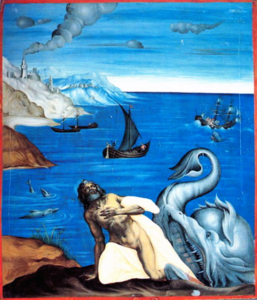
The Prophet Jonah a painting by Demetrios Stravakis (Wikimedia)
BY
JIM GERRISH
Copyright © 2026 Jim Gerrish
Light of Israel Bible Publications
Colorado Springs, CO
INTRODUCTION
Carles Feinberg, who is an authority on Jewish history, says of Jonah, “Disbelief has attacked this book probably more than any other in the Bible. It has been made the butt of ill-advised humor and undeserved ridicule.” 1 However, we should note that Jesus did not make a joke of Jonah. Rather, he used the book to make a clear prediction of his own Resurrection, as we see in Matthew 12:39-41 and 16:4 (see the parallel account in Luke 11:29-30). Neither do the Jewish people scoff at Jonah. Rather, they read the book during their most holy festival, the Day of Atonement.
Many unbelieving writers have claimed that this little book was simply taken from one of the many pagan myths. To name a few, there was the deliverance of Andromeda from a sea monster, Arion, who was thrown into the sea by sailors, and carried to shore on a dolphin, Hercules, who was three days in the belly of a sea monster as he tried to save Hesione. Irish Anglican clergyman and commentator, Andrew Faussett says, “Probably the heathen fables are, vice versa, corruptions of the sacred narrative, if there be any connection.” 2
We do not know much about Jonah. We know his name and his father’s name, as we see later in the first verse. According to a reference in 2 Kings 14:25, Jonah was from the Galilee city of Gath Hepher. This little town is some 2-3 miles (3-5 km) northeast of Nazareth. This is the only other mention of the prophet in the Old Testament outside the Book of Jonah itself. So Jonah was a prophet who came from Galilee. This disputes the “learned” Pharisees. In John 7:52, they declared that no prophet had ever come out of Galilee.
Jonah appeared in the eighth century BC. The passage in 2 Kings that we mentioned tells us that Jonah prophesied regarding the Israelite king Jeroboam II. His reign occurred during the years 793 to 753 BC. Therefore, Jonah was one of the earliest writing prophets, along with Hosea and Amos.3 We have to admit that Jonah’s book is unusual since it has very little prophecy and a lot of history in it.
We cannot miss the fact that Jonah was a very reluctant prophet. God sent him to the great city of Nineveh, but he refused to go. Instead, he went in the opposite direction to the area of Tarshish. His rebellious trip was interrupted by a whale of a tale.
CHAPTER 1
“The word of the LORD came to Jonah son of Amittai: ‘Go to the great city of Nineveh and preach against it, because its wickedness has come up before me’” Jonah 1:1-2.
The Lord commanded Jonah to go to the great city of Nineveh and preach. From what we know, Nineveh was indeed a great city. According to ancient historians, Nineveh was the world’s foremost city at that time.1 Later in the book, we will see that it took the prophet a three-day walk just to visit the city. English theologian Peter Pett adds, “That great city was probably indicating Greater Nineveh, which was made up of four large cities seen as forming one.” 2
Paul Butler gives the following description of Nineveh from an ancient writer, Diodorus: “It was the greatest city of antiquity with a population of 600,000, some 80 miles in circumference. Upon its walls 100 feet high, flanked with 1,500 towers, each 200 feet high, four chariots could drive abreast…” 3 We can understand how large the city was when we look to the last verse of the book. God tells us that there were 120,000 infants in the city.
Nineveh was founded by Nimrod (Gen. 10:11). It was a very wicked city. Their evil had become a worldwide scandal, and that wickedness had come up before God. We will note later how their wickedness was apparent in their cruel treatment of prisoners. These were often stripped naked and led along with hooks placed in their noses and lips. Ministering to Nineveh was a little like trying to minister to ISIS or HAMAS today. Thus, we can see why the Book of Jonah is called the great missionary book of the Old Testament.4
“But Jonah ran away from the LORD and headed for Tarshish. He went down to Joppa, where he found a ship bound for that port. After paying the fare, he went aboard and sailed for Tarshish to flee from the LORD” (1:3). We might wonder why Jonah did not want to go to Nineveh. First of all, Nineveh would soon be the capital city of Assyria, and the Assyrians would be bitter enemies of Israel.
James Montgomery Boice, noted speaker on the Bible Study Hour, says, “If we can imagine the word of the Lord coming to a Jew who lived in New York during World War II, telling him to go to Berlin to preach to Nazi Germany, and instead of this, he goes to San Francisco and takes a boat for Hong Kong.” 5 That might sum up some of Jonah’s feelings about going to Nineveh.
There is a second reason that comes out clearly in the latter part of the book. Jonah knew that the Lord was a merciful God. He was concerned that there might be repentance among the people and that his enemies would be spared.6 Moody teacher and broadcaster, John Phillips, sees Jonah as a classic biblical example of how God can do his perfect work with an imperfect instrument.7
We note that Jonah was headed for Tarshish. The Greek historian Herodotus tells us that Tarshish was known as Tartessus, and it was located in southern Spain.8 Other writers speak of it as a Phoenician mining community through the Straits of Gibraltar and on the Atlantic coast of Spain. In short, Jonah was going to the end of the world in those days, as far in the opposite direction as he could travel away from God’s assignment. Jonah had forgotten Psalm 139:7-10: “Where can I go from your Spirit? Where can I flee from your presence? If I go up to the heavens, you are there; if I make my bed in the depths, you are there. If I rise on the wings of the dawn, if I settle on the far side of the sea, even there your hand will guide me, your right hand will hold me fast.”
JONAH’S VOYAGE AND THE GREAT STORM
We notice that he went down to Jaffa, Israel’s ancient seaport from the times of Solomon. Commentators note that his course was “downhill.” It seems to always be downhill when we run away from the Lord. At Jaffa, he found a ship going to Tarshish, and he bought his ticket. Boice, citing Barnhouse, says, “It is always that way. When you run away from the Lord, you never get to where you are going, and you always pay your own fare. On the other hand, when you go the Lord’s way, you always get to where you are going, and he pays the fare.” 9 It is interesting that centuries later, it was at Jaffa where the Lord called Peter to take the gospel to the Gentiles at the house of Cornelius.10
So Jonah boarded his ship in an effort to get as far away from God as possible. Boice wonders if he noticed the rats getting off the ship as he got on.11 Baptist theologian Bob Utley notes that the ship was probably a Phoenician vessel that may have had two cargo decks with a third half-deck. If so, it would have required 30 to 50 rowers.12 Bible scholars Pfeiffer & Harrison add that this is the only place in the Old Testament where a ship is described as having lower and upper covered decks. This is made clear in the Hebrew text.13
“Then the LORD sent a great wind on the sea, and such a violent storm arose that the ship threatened to break up” (1:4). In Psalm 104:4, we notice how God makes the winds his messengers or servants. It seems to be an unwritten rule of creation that our sin brings difficulty and even destruction to other people. Boice reminds us of Achan’s sin, where the army of Israel was defeated, and David’s sin in numbering Israel, where 70,000 died of pestilence.14
Phillips comments, “When Jonah ran away from God, he upset the whole balance of nature. We are distinctly told that the bad weather was a result of Jonah’s bad behavior.” 15 It makes us wonder how many of the bad things that happen today in nature are the result of people’s sins. John, in his gospel, tells us that the world was made by the word of God (Jn. 1:1-4). When we go against God’s word, all of nature begins to work against us.
Boice goes on to bring Jonah’s sin up to date, saying, “We have to realize…that this is how it usually is with the world; the storm is unleashed because of the unfaithfulness of the church and Christians…While the storm was raging, Jonah, who represents the church, was asleep deep within the hold of the ship.” 16
“All the sailors were afraid and each cried out to his own god. And they threw the cargo into the sea to lighten the ship. But Jonah had gone below deck, where he lay down and fell into a deep sleep. The captain went to him and said, ‘How can you sleep? Get up and call on your god! Maybe he will take notice of us so that we will not perish” (1:5-6). Feinberg notes how it is well known that sin brings insensibility with it. He says that it is a shame when the prophet of God has to be called to prayer by a heathen.17
This must have been some storm. These were experienced and hardened sailors, and they were terrified, even to the point of throwing away the precious cargo. The early church father Chrysostom said: “They threw overboard the wares that were in the ship into the sea; but the ship was not getting any lighter, because the entire cargo still remained within it, the body of the prophet, the heavy cargo, not according to the nature of the body but from the weight of sin. For nothing is so heavy and onerous to bear as sin and disobedience.” 18 American Pastor, Bible teacher, and author, David Guzik, wonders if their request seemed ironic to Jonah. The soldiers were demanding that he call on his God, but his only reason for being on the ship was to escape from his God.19
Phillips sighs, “Jonah may well have been ashamed that he, a prophet and the only man on board who knew the true and living God, was not on speaking terms with him.” 20
“Then the sailors said to each other, ‘Come, let us cast lots to find out who is responsible for this calamity.’ They cast lots, and the lot fell on Jonah” (1:7). The sailors seemed to be well aware that a sinful person could work havoc with the weather and other things on earth. The casting of lots was an ancient biblical practice. Even the Urim and Thummim (cf. Exo. 28:30) were a type of casting lots. We see the practice in several places, such as Joshua 7:16, 15:1, 1 Samuel 14:36-42, and even in Acts 1:26.
The casting of lots was a valid system of determining God’s will in the Old Testament. Proverbs 16:33 says: “The lot is cast into the lap, but its every decision is from the LORD.”
After Acts 1:26, we no longer see the lot cast by people in the Bible. Rather, we believers can now receive our directions from God’s Holy Spirit, which dwells in each one of us.
Jonah was probably not the least surprised to be pointed out as the culprit. He had even told the sailors that he was running away from God. It is never good to be in the company of such folk.
“So they asked him, ‘Tell us, who is responsible for making all this trouble for us? What kind of work do you do? Where do you come from? What is your country? From what people are you?’” (1:8). All of a sudden, Jonah was the center of attention and they seemed to have a hundred questions to ask him. They were urgent life-and-death questions.
“He answered, ‘I am a Hebrew, and I worship the LORD, the God of heaven, who made the sea and the dry land’” (1:9). They were further alarmed to learn that he was a Hebrew and that he served the God who made the sea in the first place. They surely needed to get in touch with this God at that very moment. Here, Jonah calls himself a “Hebrew.” This was the description used by outsiders, but they called themselves “Israelites.” 21
“This terrified them and they asked, ‘What have you done?’ (They knew he was running away from the LORD, because he had already told them so.) The sea was getting rougher and rougher. So they asked him, ‘What should we do to you to make the sea calm down for us?’” (1:10-11). It was the great preacher Charles Spurgeon who said that God never allows his children to sin successfully.22 Jonah was learning that truth the hard way. Fourth-century Christian poet and writer Paulinus of Nola wrote: “Nature, which belongs to the almighty Lord, realized that [Jonah] was revolting, and it was afraid to play conspirator by transporting the guilty man safely through its domain: it chained the runaway with winds and waves.” 23
“‘Pick me up and throw me into the sea,’ he replied, ‘and it will become calm. I know that it is my fault that this great storm has come upon you.’ Instead, the men did their best to row back to land. But they could not, for the sea grew even wilder than before” (1:12-13). Jonah’s reply leaves much to be desired. It sounds quite negative and almost suicidal. He should have answered: “It is obvious what we must do. God wants me to go to Nineveh, and we will not be safe until I do. Turn the boat around. Let’s go back. Then the storm will stop…” 24
“Then they cried out to the LORD, ‘Please, LORD, do not let us die for taking this man’s life. Do not hold us accountable for killing an innocent man, for you, LORD, have done as you pleased.’” Then they took Jonah and threw him overboard, and the raging sea grew calm” (1:14-15). We have to give these pagan seamen credit in that they did not want to sacrifice Jonah just for the sea to be calm. Phillips notes how these pagan mariners were aghast at the idea of deliberately throwing a man overboard. They seemed to be horrified at this as much as they were by the storm.25
The early church father Jerome says of this situation, “The text does not say they seized him or that they threw him in, but that they took him, carrying him as one [deserving] respect and honor.” 26 The seamen must have been amazed to note that when Jonah hit the water, the awful storm immediately subsided.
JONAH AND THE BIG FISH
At this the men greatly feared the LORD, and they offered a sacrifice to the LORD and made vows to him. Jonah 1:16
Generally, people make sacrifices to request a miracle or some other good thing from the Lord. These sailors got their miracle and good thing and then made their sacrifice afterward. Guzik notes how many commentators feel that these sailors became followers of the true God.27
“Now the LORD provided a huge fish to swallow Jonah, and Jonah was in the belly of the fish three days and three nights” (1:17). Since it was the day before submarines, the Lord provided a huge fish to swallow Jonah. In Bible tradition, this fish has come to be known as a whale, but the Hebrew words say dag gadol or big fish. This sounds impossible, but there have been stories of men being swallowed by big fish and surviving. Here are a couple of stories.
A case was reported in the year 1758 when a sailor fell overboard from a frigate, in very stormy weather, into the Mediterranean Sea, and was immediately taken into the jaws of a shark, disappearing into its innards. The captain, however, ordered a gun, which was standing on the deck, to be discharged at the shark, and the cannonball struck it, with the result that it vomited the sailor whom it had swallowed up again. The sailor was then taken up alive into the boat, which had been lowered in order to rescue him, and was very little hurt.28
In February 1891, the crew of the whaling ship Star of the East sighted a large sperm whale off the Falkland Islands. They harpooned the whale, and in its death throes, it swallowed a man named James Bartley. A day and a half later, his shipmates, who thought he had drowned – found him unconscious in the whale’s belly…he said he could breathe easily, but the heat was unbearable. His whole appearance was changed by the ordeal, for his neck, face, and hands, which had been exposed to the whale’s gastric juices, were permanently bleached to a livid whiteness.29
As followers of the Lord, we need to get used to the miraculous. The Book of Jonah is full of miracles. The storm itself was miraculous. The fact that Jonah was selected by lot was a miracle as well as the subsiding sea. Of course, the great fish appearing at exactly the right time and the swallowing of Jonah was all miraculous. His later ejection, safe and sound from the fish, was a huge miracle. Then we have the episodes of the gourd, the worm, the east wind, and finally the repentance of the Great City of Nineveh.30
The prophet Jonah could exclaim with the psalmist: “The LORD has chastened me severely, but he has not given me over to death” (Psa. 118:18).
CHAPTER 2
“From inside the fish Jonah prayed to the LORD his God.” Jonah 2:1
Virtually this whole chapter relates a prayer offered by Jonah as he was inside the big fish. Boice says, “In the water and then in the great fish, he learned what hell was like, and it was there at the nadir of this misery that he repented and turned to God again…Thomas John Carlisle wrote, ‘I was so obsessed with what was going on inside the whale that I missed seeing the drama inside Jonah.’” 1
We cannot even imagine what it was like to be thrown overboard and to be swallowed by a large sea creature. I suppose that the very first prayer Jonah prayed was a sincere thanksgiving that he was somehow still alive. No doubt he thought he was drowning in all this action. He might have been partially unconscious or insensible. He likely prayed the words of Psalm 139:18, “…when I awake, I am still with you.” If the big fish were a shark, Jonah had escaped the razor-sharp teeth. Whether shark or whale, both were magnificent killing and meat-processing machines. Jonah must have been in extreme discomfort even as he cried out to God.
Many writers have long doubted that the fish was a whale. They have testified that a whale has too small a mouth to swallow a man. Boice says that a sperm whale might have a mouth 20 feet long, 15 feet high, and 9 feet wide. That would mean that the mouth would be larger than most rooms in an average-sized house. The food of choice for a sperm whale would largely be squid, and these are often much larger than a man.2 Can we imagine what it was like to be sliding down the fish’s throat, covered with squid, and maybe an octopus or two? What a tangled, slimy mess!
“He said: ‘In my distress I called to the LORD, and he answered me. From deep in the realm of the dead I called for help, and you listened to my cry’” (2:2). There is just no impossible problem that is too difficult for God. British Bible scholar, Donald Guthrie, comments: “What Jonah endured ‘figuratively (Heb. 11:19 – a similar figure of death) Jesus endured in reality…As Jonah cried, ‘I am cast out from your presence; (v. 4),’ so Christ was constrained to cry, ‘My God, my God, why hast thou forsaken me?’ (Mt. 27:46).” 3
Several commentators have noted that Jonah was a man saturated with the scriptures, particularly the Psalms. The prophet was not provided with a Bible scroll, a table, a chair, and a candle so he could read inside the fish. Instead, he was in the process of being digested with gastric juices splashing upon his body and inside temperatures probably close to 100 degrees Fahrenheit. He illustrates for us how important it is for us to have the word of God hidden in our hearts.
James Burton Coffman, Churches of Christ theologian and commentator, lists some of the Psalms that the prophet may have been referring to:
Jonah 2:3 b Psalms 18:7; Psalms 120:1
Jonah 2:4 b Psalms 18:6; Psalms 30:4
Jonah 2:5 Psalms 42:8
Jonah 2:6 Psalms 31:23; Psalms 5:8
Jonah 2:7 Psalms 18:8; Psalms 69:2
Jonah 2:8 Psalms 18:17; Psalms 30:4; Psalms 103:4
Jonah 2:9 Psalms 142:4; Psalms 143:4; Psalms 18:7; Psalms 5:8
Jonah 2:10 Psalms 88:3; Psalms 31:7; Psalms 26:7; Psalms 50:14; Psalms 50:23; Psalms 42:5; Psalms 116:7. 4
Phillips comments: “For a little while, Jonah was allowed to reap what he had sown. He had rejoiced at the thought of God’s judgment being poured out on Nineveh. Now he found out what it was like to be under God’s judgment…Having gloated over the nasty medicine that God had bottled for Nineveh, he was forced to take a large dose of it himself.” 5
From the belly of Sheol, the abode of the dead, Jonah perceived that God had heard his pitiful cry. Perhaps he had cried out in the words of Psalm 18:5, “The cords of the grave coiled around me; the snares of death confronted me.” Then the answer was acknowledged: “You, LORD, brought me up from the realm of the dead; you spared me from going down to the pit” (Psa. 30:3). Although Jonah was still in the belly of the fish, he knew by faith that deliverance was on the way.
“You hurled me into the depths, into the very heart of the seas, and the currents swirled about me; all your waves and breakers swept over me. I said, ‘I have been banished from your sight; yet I will look again toward your holy temple’” (2:3-4). Here, the prophet seems to be calling out in the words of Psalm 42:7, “Deep calls to deep in the roar of your waterfalls; all your waves and breakers have swept over me.” In all his distress, the prophet speaks a word of faith that he will once again see the holy temple in Jerusalem. In Jonah’s day, that temple was still standing.
“The engulfing waters threatened me, the deep surrounded me; seaweed was wrapped around my head” (2:5). We can imagine that the horrible storm had stirred up great masses of seaweed. Jonah was tangled up in it and even had it wrapped around his head. I wonder if Jonah may have still had some matted seaweed stuck in his hair when he showed up to preach at Nineveh. There was probably something about Jonah’s looks that made believers out of the people.
“To the roots of the mountains I sank down; the earth beneath barred me in forever. But you, LORD my God, brought my life up from the pit” (2:6). After the large fish had swallowed Jonah, it probably took a deep dive to the foot of the mountains. We can hardly imagine the crushing pressures of such a dive. Yet, the prophet still had hope. He may have referred here to Psalm 18:15-16. “The valleys of the sea were exposed and the foundations of the earth laid bare at your rebuke, LORD, at the blast of breath from your nostrils. He reached down from on high and took hold of me; he drew me out of deep waters.”
Throughout this section, we see how Jonah did not just have faith that he would be delivered, but he had faith based on the unfailing word of God.
“When my life was ebbing away, I remembered you, LORD, and my prayer rose to you, to your holy temple” (2:7). As Jonah was fainting away, he might have remembered the words of Psalm 18:6, “In my distress I called to the LORD; I cried to my God for help. From his temple he heard my voice; my cry came before him, into his ears.” Adam Clarke, 19th-century British Methodist scholar, tries to sum this up, saying, “Here prayer is personified, and is represented as a messenger going from the distressed, and entering into the temple of God, and standing before him.” 6
“Those who cling to worthless idols turn away from God’s love for them” (2:8). Worthless idols or lying vanities were descriptive names for the idols of paganism. The pagan world was filled with all kinds of idols, thousands of them. Unfortunately, the people of Israel were involved in this idolatry as well, particularly in the worship of Baal. God’s people then and now have not totally escaped from idolatry. William Banks says: “We do not bow and scrape before heathen images, but we are also idolaters. Not in the crude way of Jonah’s time, but in a more subtle, sophisticated, and therefore a more sinister way. We have merely made some substitutions. In the place of Ashtaroth, Baal, Chemosh, Dagon, Diana, Isis, Mammon, Molech, and Nebo, we have put alcohol, ambition, automobiles, greed, Hollywood, jazz, money, nicotine, pleasure, science, sports, and sex…” 7
“But I, with shouts of grateful praise, will sacrifice to you. What I have vowed I will make good. I will say, ‘Salvation comes from the LORD’” (2:9). Guzik feels that at the end of Jonah 2:9 it is clear enough that Jonah has repented.8 Jonah may well have been recalling parts of Psalm 50:14-15: “Sacrifice thank offerings to God, fulfill your vows to the Most High, and call on me in the day of trouble; I will deliver you, and you will honor me.” Or perhaps he had Psalm 42:4 in mind: “These things I remember as I pour out my soul: how I used to go to the house of God under the protection of the Mighty One with shouts of joy and praise among the festive throng.” It is truly amazing how saturated Jonah’s mind was with scripture. His experience is a good lesson for us to do the same, so we can overcome in our day of trouble.
“And the LORD commanded the fish, and it vomited Jonah onto dry land” (2:10). Banks again notes that in Jonah’s deliverance, the word “vomit” has its only pleasant usage in the whole Bible.9 Warren Wiersbe, American commentator and broadcaster, remarks, “What an ignominious way for a distinguished prophet to arrive on shore!” 10
There has been a lot of speculation about this verse and about where Jonah was taken to and vomited out. One commentator thought he was taken all the way to Nineveh. That would have been quite impossible since there was no ocean access there. Our God is a very practical God, and he does not waste time or money. We can almost assume that during the three days and nights, the big fish was making its way back to the coasts of Israel or Lebanon. There would still have been over 400 miles (643 km) of travel left for Jonah before he could get to Nineveh.
Well, the story of Jonah and the big fish was a whale of a tale. It is the kind of thing a person would want to write a book about. Two great messages are clear throughout. Pett sums up the first, that the Lord God was in full control of creation.11
The second message was mentioned in our introduction in passages Matthew 12:39-41; 16:4, and in Luke 11:29-32. Jesus says, “For as Jonah was three days and three nights in the belly of a huge fish, so the Son of Man will be three days and three nights in the heart of the earth” (Matt. 12:40). Wiersbe notes how the “sign of Jonah” is clearly illustrated in his experience of ‘death,’ ‘burial,’ and ‘resurrection on the third day.’ This was the only sign Jesus gave to the nation of Israel.” 12
CHAPTER 3
Then the word of the LORD came to Jonah a second time: Jonah 3:1
Chuck Smith, founder of the Calvary Chapel movement, remarks how God brings us back many times to the place of failure, and that is the place where we can start again.1 In this sense, God is the God of second chances. We have only to think of Old Testament figures like Moses, who failed at his first attempt to deliver Israel from Egypt but who later succeeded wonderfully well. We can also think of New Testament figures like young John Mark, who failed on his first mission trip but who succeeded later and even wrote one of the gospels. Then we surely think of Peter, who denied Jesus and failed him at his crucifixion, but who was later reinstated, becoming the chief apostle of the church.
Coffman surmises that at his earliest convenience, Jonah went up to Jerusalem, worshipped, and paid his vows as he had indicated in his psalm-prayer.2 It is even possible that the fish vomited the prophet out on the Israeli coastline near the road leading up to Jerusalem. He could have paid his vows on the way to Nineveh. If he had not done that, he would certainly have paid his vows promptly when he arrived home.
“Go to the great city of Nineveh and proclaim to it the message I give you” (3:2). By all accounts, Nineveh was a very great and large city. Commentators try to outdo each other in describing the vastness and greatness of Nineveh. They seem to agree that the circumference of the city was 60 miles (96 km) and the population was some 600,000 souls.3 Paul Butler reports that from the record of the ancient writer Diodorus, Nineveh had walls 100 feet high (30 m), with 1,500 towers, each 200 feet high. He notes that four chariots could run abreast on top of the wall. 4 Other writers say that it was only three chariots wide.
We must understand that ancient cities had a walled portion that was surrounded by smaller settlements outside the wall. In fact, many people lived outside and carried on their occupations there. However, when danger threatened, these people quickly came inside the walled and protected area.5
JONAH’S PREACHING
Jonah began by going a day’s journey into the city, proclaiming, “Forty more days and Nineveh will be overthrown.” Jonah 3:4
It appears that Jonah went about a third of the way into Nineveh as he preached. Phillips says, “These eight words formed the shortest of all prophecies.” 6 We see the number “forty” on many occasions in Scripture. The number is often associated with humility, testing, and judgment (Gen. 7:4; Exo. 24:8; 1 Ki. 19:8; Mat. 4:2).
“The Ninevites believed God. A fast was proclaimed, and all of them, from the greatest to the least, put on sackcloth” (3:5). Jonah’s preaching had an immediate and astounding effect upon the Ninevites. There may be two or three reasons for this. First, God’s Spirit must have fallen on the people, leading them to an immediate repentance. Second, the appearance of Jonah must have shocked them. Apparently, the gastric fluids of the big fish had probably turned his skin white, and he may have had some matted seaweed stuck in his hair. He was likely a sight to behold and a holy sight at that. Third, there may have been a period of awakening and revival in the area. Pfeiffer & Harrison report that there might have been a brief swing toward monotheism in the nation around that time. There were also a couple of severe plagues in the country that might have awakened the people to spiritual realities.7
It is even possible that the strange story of Jonah had reached Nineveh before the prophet, making him a sign to them.8 Utley chimes in here with a quip, “What a difference a room in the fish hotel can make!” 9
NINEVEH’S TOTAL REPENTANCE
When Jonah’s warning reached the king of Nineveh, he rose from his throne, took off his royal robes, covered himself with sackcloth and sat down in the dust. Jonah 3:6
Feinberg feels that the whole city turning to God was highly unusual and that nothing approximating it has ever happened in the history of revivals.10 It was an amazing example of national repentance. Can we even imagine the king taking off his royal robes, clothing himself with itchy and ugly sackcloth, and sitting himself down in the dust?
“This is the proclamation he issued in Nineveh: ‘By the decree of the king and his nobles: Do not let people or animals, herds or flocks, taste anything; do not let them eat or drink. But let people and animals be covered with sackcloth. Let everyone call urgently on God. Let them give up their evil ways and their violence. Who knows? God may yet relent and with compassion turn from his fierce anger so that we will not perish’” (3:7-9). In the Bible, we see fasting mentioned a lot of times. However, I cannot remember any instance when the animals were required to fast, or especially were required to do a total fast of food and water. We can imagine that there was a chorus of bellowing all over the town. I can remember as a child on the farm once hearing the animals sadly complain when the water troughs were left empty.
We are not told how long this total fast continued. Perhaps it was just for a day. Certainly, it did not go longer than three days because the human body cannot be sustained without fluids much beyond that limit. Pfeiffer & Harrison tell us that it was a common practice among Semitic people to include their animals when they endured times of mourning and distress.11 Herodotus, the ancient historian, tells of one Masistios, a Persian general who fell in the battle of Platea. To mourn his death, the Persians shaved the hair off their horses.12 Clarke mentions how Virgil relates that the mourning for the death of Julius Caesar was so general that the cattle neither ate nor drank.13
The people of Nineveh certainly needed to repent. In 1:1-2, we talked about Nineveh’s cruelty in battle. They did a lot of other atrocious things. Wiersbe tells of their impaling live victims on sharp poles and leaving them to die in the hot desert sun. They beheaded people and stacked their skulls at the city gate. They even skinned people alive. Then they killed captive babies and young children rather than having to take care of them.14
“When God saw what they did and how they turned from their evil ways, he relented and did not bring on them the destruction he had threatened” (3:10). The king got his request answered by a very willing people. The horrible destruction of this great city was delayed, and Nineveh received about another 150 years of existence.
We know from Bible history that the city eventually continued its cruel and heartless ways.
Later, the prophet Nahum spoke of its total destruction. Before that destruction could come, Nineveh and the Assyrians destroyed the northern kingdom of Israel (722 BC). Yet, just as the prophet spoke (Nah. 3:10), the great city of Nineveh fell in 612 BC, being conquered by the Medes and Persians. The city was so completely destroyed that when Alexander the Great fought the Battle of Arbela near the site in 331 BC, he did not realize that there had ever been a city there.15
CHAPTER 4
But to Jonah this seemed very wrong, and he became angry. Jonah 4:1
To Jonah, the show of God’s compassion was wrong, and it seemed wrong enough to make the prophet very angry. As Boice says, “Jonah is angry. He had obeyed God, doing what God wanted, but God had not done what Jonah wanted.” 1 Apparently, Jonah would have been happy if Nineveh had been burned to cinders. No doubt he thought his Israel brethren would have considered him a false prophet for not bringing about the destruction of their enemy.
Normally, a preacher would be happy at the repentance of his people, but Jonah was truly sad.
“He prayed to the LORD, ‘Isn’t this what I said, LORD, when I was still at home? That is what I tried to forestall by fleeing to Tarshish. I knew that you are a gracious and compassionate God, slow to anger and abounding in love, a God who relents from sending calamity” (4:2).
While this is stated as a prayer, it is more of a complaint to God. It is really an “I told you so” offered up to the merciful God. Phillips says, “This truth about God, which should set joy bells ringing in every human heart, actually filled Jonah with rage.” 2 Jonah’s frame of mind could be expressed in these lines of Jonathan Swift:
We are God’s chosen few,
All others will be damned;
There is no place in heaven for you,
We can’t have heaven crammed. 3
“Now, LORD, take away my life, for it is better for me to die than to live. But the LORD replied, ‘Is it right for you to be angry?’” (4:3-4). Jonah was angry and discouraged enough to come up with a death wish. Commentator Michael Griffiths compares his attitude to that of Elijah in 1 Kings 19:4. It seemed that both men had risked their lives for nothing, and that Israel’s enemies remained powerful. Griffiths feels that both men were close to a nervous breakdown.4
A POUTING PROPHET
Jonah had gone out and sat down at a place east of the city. There he made himself a shelter, sat in its shade and waited to see what would happen to the city. Jonah 4:5
Jonah went east from the city and built himself a shelter. The Hebrew word is sukkah, which means shelter, booth, or tabernacle. Perhaps it was like the tabernacles that Israel once built in the wilderness (cf. Lev. 23:40-42). Boice comments, “Since God had sent Jonah to Nineveh to preach to the people and since, as a result of Jonah’s preaching, they had repented and turned to Jehovah, Jonah should have stayed and taught them more perfectly, becoming a Calvin to Nineveh as the great Protestant reformer was blessed to the city of Geneva.” 5
“Then the LORD God provided a leafy plant and made it grow up over Jonah to give shade for his head to ease his discomfort, and Jonah was very happy about the plant” (4:6). There has been quite a lot of discussion among commentators as to the nature of this plant. The Bible scholar Feinberg names it as the Ricinus plant, or the Palma Christi. He says it is native to India, Palestine, Arabia, Africa, and eastern Europe. It can grow eight to ten feet tall, but its stalk is easily injured. It has large leaves and can mature quickly.6 We sense that the maturation was not entirely natural. The plant seems to have sprung up in a rather miraculous manner. Jonah was delighted that the plant shaded him from the blistering sun and hot east wind. Coffman feels that there are millions of Jonahs in our society today. These folks are glad for the comforts and luxuries they enjoy. However, they do not consider the great hope of the soul’s eternal redemption in Jesus Christ.7
“But at dawn the next day God provided a worm, which chewed the plant so that it withered” (4:7). We see the finger of God both in the creation and destruction of this plant. However, Faussett reports that black caterpillars can strip the leaves from the Palma Christi in one night and leave only the bare ribs.8
“When the sun rose, God provided a scorching east wind, and the sun blazed on Jonah’s head so that he grew faint. He wanted to die, and said, ‘It would be better for me to die than to live’” (4:8). This scorching east wind is probably related to the Hamsin (Khamsin) east wind that often strikes Israel in the spring and summer. The wind can last for days, and it greatly reduces visibility and comfort. It often leaves a coating of desert dust on the automobiles and everything else. I think we can say that God was putting the heat on Jonah.
MAJORING ON MINORS
But God said to Jonah, “Is it right for you to be angry about the plant?” “It is,” he said. “And I’m so angry I wish I were dead.” Jonah 4:9
Frederick Brotherton Meyer, English pastor and evangelist, says, “The withering of the gourd extorted bitter reproaches from the prophet who would have beheld the destruction of Nineveh without a tear.” 9 It is clear that Jonah was majoring on minors. He was not seeing people and their needs, but only his own selfish needs. He had stopped serving God and others and had become only a spectator. God was patiently trying to help the prophet see that he is the God of all people.
“But the LORD said, ‘You have been concerned about this plant, though you did not tend it or make it grow. It sprang up overnight and died overnight’” (4:10). This conversation illustrates just how far the Creator will go and how low he will bend to deal with our pitifully small problems.
While Jonah is a rather sad story, it lends itself to some levity. Let us bring this account up to date just a bit. (Telephone rings… ringy…ding…ding)… “Hello, why hi Jonah, it has been so long since we talked, son!”… “So how are things with you?”… “You quit your job!”… “You say it was a dispute with the boss?”… “That’s sad. The Lord was really doing things through you there. It was like a big revival.”… “So where are you living now?”… “You are living at Gourdville? I never heard of that town.”… “You say there is a terribly hot east wind there?”… “Why not adjust the thermostat?”… “You mean you are homeless?”… “You are living under a shade tree?”… “I never heard of worms eating a shade tree in one night!”… “You say your Whale Hotel was a much worse place to live. Maybe you need to tell us all about that son…?”
On the serious side, Pfeiffer and Harrison call Jonah’s concern for the gourd selfish and that he was sorry for its destruction simply because it served his personal comfort. They note how God’s concern for people is always unselfish. God seeks to give the greatest comfort of all by delivering us from sin.10
“And should I not have concern for the great city of Nineveh, in which there are more than a hundred and twenty thousand people who cannot tell their right hand from their left – and also many animals?” (4:11). Phillips comments: “Jonah had problems. He did not know God well enough to grieve over sin the way God grieves. Neither did he know God well enough to rejoice over the repentance of sinners the way God rejoices. Jonah had great difficulty accepting the fact that God loved Gentiles just as much as he loved Jews and the fact that he loved the cruel and oppressive Assyrians just as much as he loved him.” 11 God even had a tender concern for the animals involved. We Gentiles should rejoice because Jonah is an early picture of how God would reach out and save millions and billions of Gentile people in the coming centuries. As the Scripture asks, “Or is God the God of Jews only? Is he not the God of Gentiles too? Yes, of Gentiles too,” (Rom. 3:29).
Jonah also teaches us not to waste our time and prayers on piddling things. Phillips again mentions that a lot of Christians are a lot like Jonah. They get all upset over a shrub in their gardens because it has the blight, and they do not notice the doom of millions of people around them, even their own families and friends. These millions are headed for a long eternity.12 They prefer a shrub to a city. We might ask ourselves, “Are we more content to remain with the ‘gourds,’ the comforts of home, than to see the message of Christ go out to the ends of the earth to both Jew and Gentile?” 13
Well, Jonah is a very important book with its message about God’s love for Gentiles and with its sign of Jesus being resurrected from the tomb after three days and three nights. However, did Jonah learn anything? We have no evidence that Jonah was ever changed. When the book ends, he remains his peevish and selfish self. The fate of Nineveh’s 600,000 souls, as well as 120,000 little ones, was no concern for him. God was still patient with him, just like he is still patient and loving with all of us. “For he says to Moses, ‘I will have mercy on whom I have mercy, and I will have compassion on whom I have compassion’” (Rom. 9:15).
ENDNOTES
Several sources I have cited here are from the electronic media, either from websites or from electronic research libraries. Thus, in some of these sources, it is not possible to cite page numbers. Instead, I have cited the verse or verses in Jonah (e.g. v. verse 1:1 or vs. verses 1:5-6) about which the commentators speak.
We highly recommend your taking a little time and watching the excellent video on Jonah.
Life in Nineveh: The Cruelest City on Earth Before Destruction https://www.youtube.com/watch?v=eIomxIWFBsY 46.20 min.
INTRODUCTION
1 Charles L. Feinberg, The Minor Prophets (Chicago: Moody Publishers, 1990), p. 133.
2 Robert D. Jamieson, A. R. Fausset, and David Brown, Commentary Critical and Explanatory on the Whole Bible, Commentary on Jonah, 1871-78, Int. https://www.studylight.org/commentaries/eng/jfb/jonah.html
3 Ibid.
CHAPTER 1
1 David Guzik, Enduring Word Bible Commentary, Jonah, vs. 2:2.
2 Peter Pett, Commentary on Joel, Peter Pett’s Commentary on the Bible, 2013, v. 1:2. https://www.studylight.org/commentaries/eng/pet/jonah.html
3 Quoted in James Burton Coffman, Coffman’s Commentaries on the Bible, Commentary on Jonah (Abilene TX: Abilene Christian University Press, 1983-1999), v. 1:2. https://www.studylight.org/commentaries/eng/bcc.html
4 Feinberg, The Minor Prophets, p. 133.
5 James Montgomery Boice, The Minor Prophets, Vol. 1 (Grand Rapids: Baker Books, 1986), p. 266.
6 Feinberg, The Minor Prophets, p. 135.
7 John Phillips, Exploring The Minor Prophets (Grand Rapids: Kregel Publications, 1998), p. 140.
8 Feinberg, The Minor Prophets, p. 135.
9 Quoted in Boice, The Minor Prophets, Vol. 1, p. 268.
10 Feinberg, The Minor Prophets, p. 135.
11 Boice, The Minor Prophets, Vol. 1, p. 267.
12 Bob Utley, Free Bible Commentary, Jonah, v. 1:3. https://www.freebiblecommentary.org/old_testament_studies/VOL10OT/VOL10COT_01.html
13 Charles F. Pfeiffer & Everett F. Harrison, The Wycliffe Bible Commentary (Chicago: Moody Press, 1979), p. 846.
14 Boice, The Minor Prophets, Vol. 1, p. 273.
15 Phillips, Exploring The Minor Prophets, p. 142.
16 Boice, The Minor Prophets, Vol. 1, p. 274.
17 Pfeiffer & Harrison, The Wycliffe Bible Commentary, p. 136.
18 Alberto Ferreiro, ed., Ancient Christian Commentary On Scripture, XIV (Downers Grove: InterVarsity Press, 2003), p. 132.
19 Guzik, Enduring Word Bible Commentary, Jonah, vs. 1:5-6.
20 Phillips, Exploring The Minor Prophets, p. 143.
21 Pett, Commentary on Joel, Peter Pett’s Commentary on the Bible, v. 1:9.
22 Warren W. Wiersbe, The Wiersbe Bible Commentary, OT (Colorado Springs: David C. Cook, 2007), p. 443.
23 Ferreiro, ed., Ancient Christian Commentary On Scripture, XIV, p. 133.
24 Boice, The Minor Prophets, Vol. 1, p. 277.
25 Phillips, Exploring The Minor Prophets, p. 145.
26 Ferreiro, ed., Ancient Christian Commentary On Scripture, XIV, p. 134.
27 Guzik, Enduring Word Bible Commentary, Jonah, vs. 1:11-16.
28 Pett, Commentary on Joel, Peter Pett’s Commentary on the Bible, Int.
29 Phillips, Exploring The Minor Prophets, p. 146.
30 Feinberg, The Minor Prophets, p. 134.
CHAPTER 2
1 Boice, The Minor Prophets, Vol. 1, pp. 281-282.
2 Ibid., p. 283.
3 D. Guthrie, J.A. Motyer, A.M. Stibbs, D. J. Wiseman, The New Bible Commentary: Revised (Grand Rapids: Wm. B. Eerdmans Publishing Co., 1970), p. 749.
4 Coffman, Coffman’s Commentaries on the Bible, Commentary on Jonah, v. 2:2.
5 Phillips, Exploring The Minor Prophets, pp. 147-148.
6 Adam Clarke, Adam Clarke Commentary, Jonah, v. 2:7. https://www.studylight.org/commentaries/eng/acc/jonah-1.html
7 Quoted in Coffman, Coffman’s Commentaries on the Bible, Commentary on Jonah, p. 2:8.
8 Guzik, Enduring Word Bible Commentary, Jonah, vs. 2:8-9.
9 Quoted in Coffman, Coffman’s Commentaries on the Bible, Commentary on Jonah, v. 2:10. 10
10 Wiersbe, The Wiersbe Bible Commentary, OT, p.1445.
11 Pett, Commentary on Joel, Peter Pett’s Commentary on the Bible, v. 2:10.
12 Wiersbe, The Wiersbe Bible Commentary, OT, p.1445.
CHAPTER 3
1 Charles (Chuck) Smith, Smith’s Bible Commentary, Commentary on Jonah, v. 3:1-10. https://www.studylight.org/commentaries/eng/csc/jonah.html
2 Coffman, Coffman’s Commentaries on the Bible, Commentary on Jonah, v. 3:1.
3 Feinberg, The Minor Prophets, p. 143.
4 Coffman, Coffman’s Commentaries on the Bible, Commentary on Jonah, v. 3:2.
5 Boice, The Minor Prophets, Vol. 1, pp. 296-297.
6 Phillips, Exploring The Minor Prophets, p. 150.
7 Pfeiffer & Harrison, The Wycliffe Bible Commentary, p. 843.
8 Feinberg, The Minor Prophets, p. 144.
9 Utley, Free Bible Commentary, Jonah, v. 3:3.
10 Feinberg, The Minor Prophets, p.145.
11 Pfeiffer & Harrison, The Wycliffe Bible Commentary, p. 848.
12 Coffman, Coffman’s Commentaries on the Bible, Commentary on Jonah, v. 3:7.
13 Clarke, Adam Clarke Commentary, Jonah, v. 3:8.
14 Wiersbe, The Wiersbe Bible Commentary, OT, p. 1447.
15 Coffman, Coffman’s Commentaries on the Bible, Commentary on Jonah, v. 3:2.
CHAPTER 4
1 Boice, The Minor Prophets, Vol. 1, p. 303.
2 Phillips, Exploring The Minor Prophets, p. 153.
3 Guzik, Enduring Word Bible Commentary, Jonah, vs. 4:2-3.
4 Quoted in Coffman, Coffman’s Commentaries on the Bible, Commentary on Jonah, v. 4:3.
5 Boice, The Minor Prophets, Vol. 1, p. 308.
6 Feinberg, The Minor Prophets, p. 150.
7 Coffman, Coffman’s Commentaries on the Bible, Commentary on Jonah, v. 4:6.
8 Fausset, et. al. Commentary Critical and Explanatory on the Whole Bible, Commentary on Jonah, v. 4:7.
9 Frederick Brotherton Meyer, Meyer’s Commentary, Jonah, vs. 4:1-11. https://www.studylight.org/commentaries/eng/fbm/jonah.html
10 Pfeiffer & Harrison, The Wycliffe Bible Commentary, p. 850.
11 Phillips, Exploring The Minor Prophets, p.137.
12 Ibid., p. 154.
13 Feinberg, The Minor Prophets, p. 152.